
By: Natalie Johnson
Shekhar Natarajan does not believe builders wait to be discovered. His career, his company, and now an Oxford medal are organized around proving the point.
San Francisco (California), May 23: Shekhar Natarajan has a definition of a builder he repeats often, in venues that have grown larger over the past two years. A builder, he says, is not a person waiting to be discovered. A builder is a person who refuses the terms of their invisibility by making something the world is eventually forced to see.
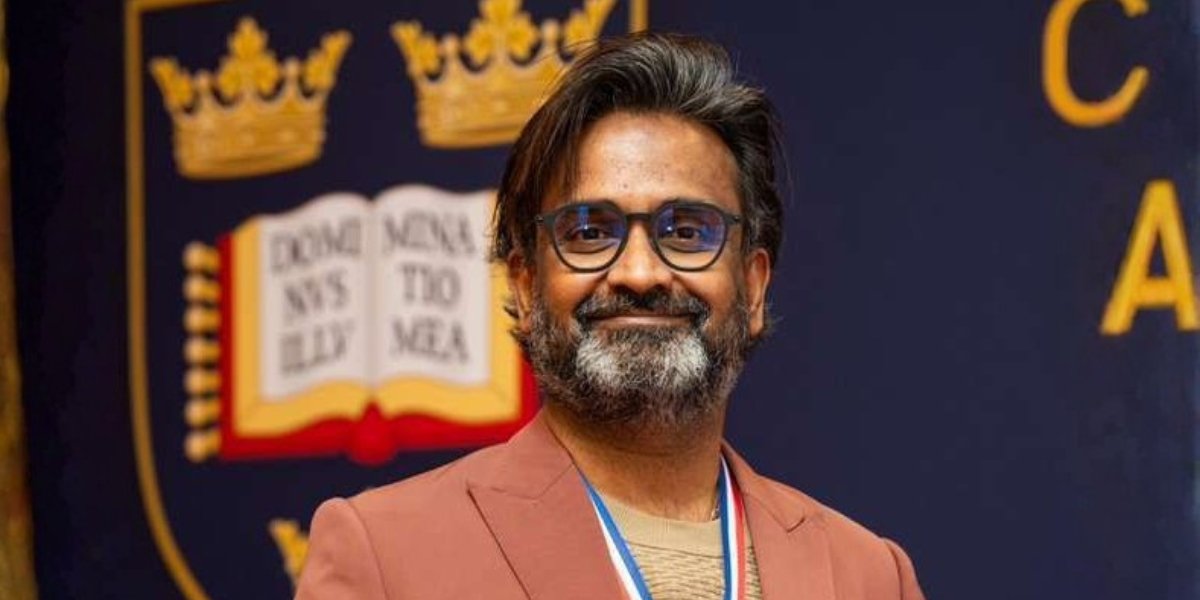
In April, the world saw it. The University of Oxford awarded Natarajan the Bodleian Medal for his work advancing artificial intelligence in the public interest. It was the third standing audience he had drawn in four months: Davos in January, the Forbes conference in Riyadh shortly after, and a hall at New Delhi’s Bharat Mandapam in February.
“I did not climb a ladder,” Natarajan told an audience in 2025. “I built rungs the ladder did not have.”
The First Pattern
Natarajan, the founder and chief executive of Orchestro.AI, did not arrive at the Bodleian Medal through the usual route. According to coverage in international outlets, he was raised in South Central India in a household without electricity. He studied under a streetlight outside. His mother pawned her wedding ring to pay his school fees and stood for a year outside a headmaster’s office to secure his admission. He arrived in the United States with thirty-four dollars and, at one point, lived out of his car. What followed was twenty-five years inside the technology operations of major American consumer brands, including Walmart, Disney, Coca-Cola, and PepsiCo, along with more than two hundred patents.
Natarajan does not describe the patents as the rewards of having arrived. He describes them as the mechanism of arrival itself. A patent, in his framing, is a builder’s argument. A working system is a builder’s argument. A company is a builder’s argument. Each one, he says, is a refusal, repeated in materials, of the proposition that the builder does not exist.
It is the disposition, more than the biography, that has shaped what he built next.
The Second Pattern
Orchestro.AI, the Dublin, California–based company Natarajan has been building since 2023, is organized around a system he calls Angelic Intelligence. He laid out the architecture in a technical paper published in April, and described it from the Oxford lectern as built around four pillars.
The Wisdom Engine filters and curates the data the system learns from. The Virtue Stack adapts the system’s reasoning to a specific field, such as healthcare, logistics, finance, or education. MACI, short for Multi-Architecture Consequential Intelligence, has multiple AI agents debate every decision before the system acts. A human-centric scoring layer measures every output against human benefit and explains the reasoning in an auditable chain.
At the operational core sit twenty-seven specialized agents, what Natarajan calls Digital Angels, each embodying a virtue drawn from a different cultural tradition. No single agent determines an output. The twenty-seven deliberate to consensus.
The same builder’s logic that produced the patents is at work here. The dominant paradigm in AI safety, Natarajan argued at Oxford, is to build a powerful model first and add filters afterward. He describes the result, in the technical paper, as a cage perpetually fighting the animal inside it.
“If you have to teach a machine not to be harmful,” he said, “you have already built the wrong machine.” The alternative, he argues, is a different machine. Angelic Intelligence is what that machine looks like in code.
Among the Builders
Natarajan’s position sits in deliberate contrast to the figures dominating the AI conversation. Sam Altman has organized OpenAI around the pursuit of artificial general intelligence, a philosophy of trajectory. Demis Hassabis frames DeepMind’s work as cognition in the service of scientific discovery. Dario Amodei has articulated, at Anthropic, what he calls safe acceleration. Natarajan is asking a different question. Not how soon, not what the machine can discover, not how to scale capability without scaling risk, but what the machine is for, and whose lives the answer is implicitly built around.
It is, in his telling, a builder’s question rather than a researcher’s. A researcher asks how to make the system better. A builder asks who the system is for.
What the Architecture Sees
Natarajan illustrates the difference with an example from the technical paper. A user tells the system that their parent is terminally ill and asks what to do with the time that is left. A conventional AI offers a list of activities. The Orchestro system, Natarajan writes, “perceives that this is not a planning question. It is a grief question, asked sideways.”
Frontier AI, Natarajan argued at Oxford, is largely being built by people and institutions that have always been visible, whether financially, geographically, or institutionally. The questions those builders ask the technology to answer are, by virtue of where they sit, the questions of the visible. A builder who once was not, he argues, asks differently.
The Argument, in Materials
Whether Angelic Intelligence works at the scale Natarajan is proposing remains, as he himself has said, an open question. More than forty patents have been filed. The architecture is built. Deployments are beginning.
The technical paper closes with a single sentence: “It does not build a bigger cage. It builds a model that does not need one.”
It is, by his own definition, a builder’s argument, repeated in materials, made impossible to ignore. The Bodleian Medal, three standing ovations, and a working system are what that looks like at scale.