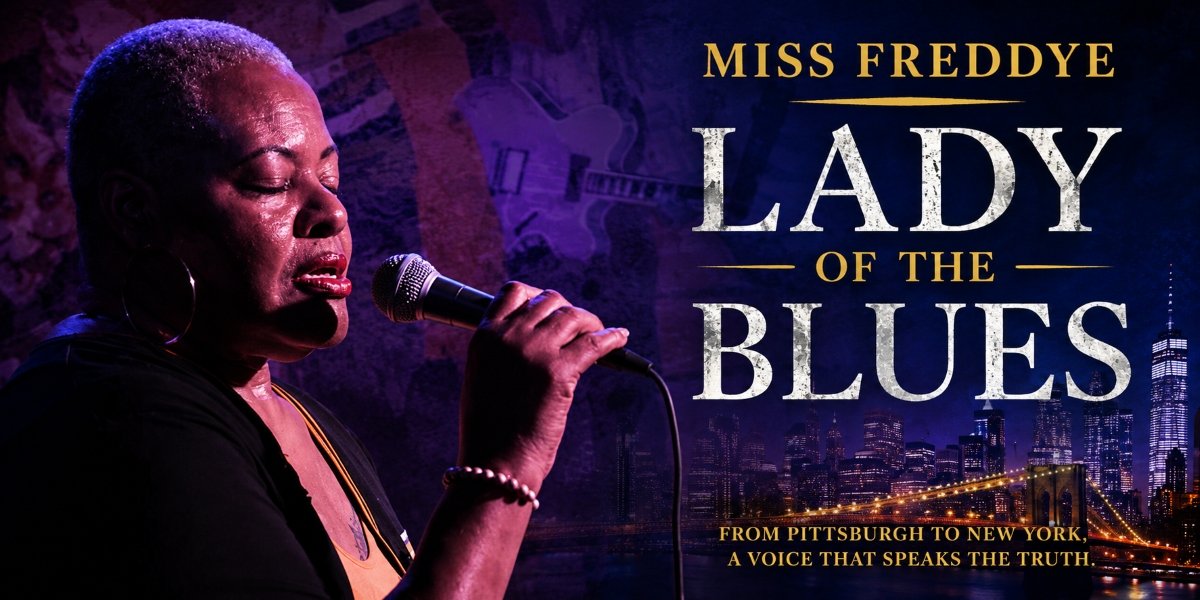

By: Simone Carter
New York has never needed geography lessons to understand the blues.
This is, after all, a city where heartbreak rides the subway at three in the morning, where gospel spills out of Harlem churches on Sunday and where generations of musicians have arrived carrying little more than a voice, a story and the determination to be heard. From Bessie Smith commanding Manhattan stages to Billie Holiday turning pain into poetry, New Yorkers have traditionally responded to singers who sound as though they mean every word.
That’s why Pittsburgh’s Miss Freddye makes sense here.
Known as the “Lady of the Blues,” Miss Freddye has built the kind of career New York tends to respect: independent, persistent and decidedly uninterested in shortcuts. Her story isn’t about an industry manufacturing a star. It’s about a woman accumulating enough life to understand what the blues actually means and then finding the courage to sing it.
For Miss Freddye, music began with gospel. Church provided an early education in the relationship between voice and emotion, teaching her that singing wasn’t simply about delivering melody. It was about communicating something larger. That spiritual foundation remains embedded in her work today, even when she’s planted firmly in blues territory.
But music represents only one chapter of her remarkable life.
For more than three decades, Miss Freddye worked as a nurse, caring for people when they were often frightened, vulnerable, or hurting. It’s difficult to imagine a better education for a blues singer. Long hospital shifts provide considerably more insight into the human condition than most songwriting seminars.
She also raised a family while pursuing music, building her career gradually rather than waiting for somebody in the industry to grant her permission.
Then life handed her something considerably more serious than a difficult gig.
Miss Freddye battled breast cancer twice.
Survival became another element of the emotional vocabulary she carries onto the stage. Yet what makes her compelling is that she doesn’t turn adversity into spectacle. Her music holds joy alongside hurt, gratitude alongside struggle. The blues, in her hands, isn’t about surrendering to misery. It’s about surviving long enough to sing about it.
New Yorkers understand that distinction.
Her professional career began gathering momentum in Pittsburgh’s blues community in the 1990s. Over the years, she developed into one of western Pennsylvania’s recognizable blues voices, earning the nickname that now follows her everywhere: Pittsburgh’s Lady of the Blues.
And eventually, Pittsburgh couldn’t contain the audience.
Her recordings began reaching listeners internationally. Miss Freddye has scored a No. 1 on the UK iTunes Blues Chart with “Slippin’ Away”, while her gospel recording “Wade in the Water” reached No. 2 on an iTunes gospel chart. For an independent blues singer building a career outside America’s traditional music-industry capitals, that reach represents more than digital bragging rights. It demonstrates that the emotional language she’s speaking travels.
Recognition has accompanied that success. Miss Freddye has collected honors from Pittsburgh’s music community, including Iron City Rocks Awards, and has received broader recognition within the blues world. Her Lady of the Blues era helped solidify a reputation already being established onstage. This was not someone borrowing blues traditions for aesthetic effect.
She belonged there.
Listen closely, and you can hear the lineage. There are traces of gospel, traditional blues, soul and the commanding female vocal tradition associated with performers such as Koko Taylor and Etta James. But imitation isn’t the point. Miss Freddye’s most important instrument isn’t simply her voice.
It’s experience.
That quality would serve her well in New York, where audiences have historically possessed a finely tuned detector for phoniness. Put her in an intimate Greenwich Village room, a Harlem blues setting or on a Brooklyn festival stage and the location might change, but the essential transaction wouldn’t. The singer tells the truth, and the audience recognizes it.
There is also something distinctly Pittsburgh about Miss Freddye that complements New York rather than conflicting with it.
Both cities understand toughness.
Pittsburgh’s version was forged around steel mills, steep hills, working neighborhoods and three rivers. New York’s comes from crowded sidewalks, impossible rents and millions of people continually reinventing themselves. Neither place is particularly impressed by empty boasting. You show up. You do the work. You survive.
Miss Freddye has done all three.
Even as international audiences discovered her, she remained deeply connected to Pittsburgh. She has supported community organizations, performed benefits and used her visibility to encourage others. Her career has become intertwined with advocacy, particularly through her experiences with cancer and healthcare.
That’s another reason her story reaches beyond genre.
Miss Freddye isn’t merely preserving blues tradition. She’s showing why that tradition still matters. The circumstances change (hospital rooms instead of cotton fields, digital charts instead of jukeboxes) but human beings still experience loss, illness, love, disappointment, faith and redemption.
As long as they do, there will be blues.
New York has heard countless singers arrive claiming they have something real to say. The city doesn’t believe all of them.
Miss Freddye wouldn’t need to make the claim.
Give her a microphone.
She’ll prove it.