


By: Clara Winslow
By all accounts, Albin Kaelin shouldn’t be a rebel. He’s a trained businessman, an accomplished industrial manager, and a respected figure in European manufacturing. But it’s precisely his refusal to accept things “just because they’ve always been done that way” that makes him one of the most important radical thinkers in sustainable design today.
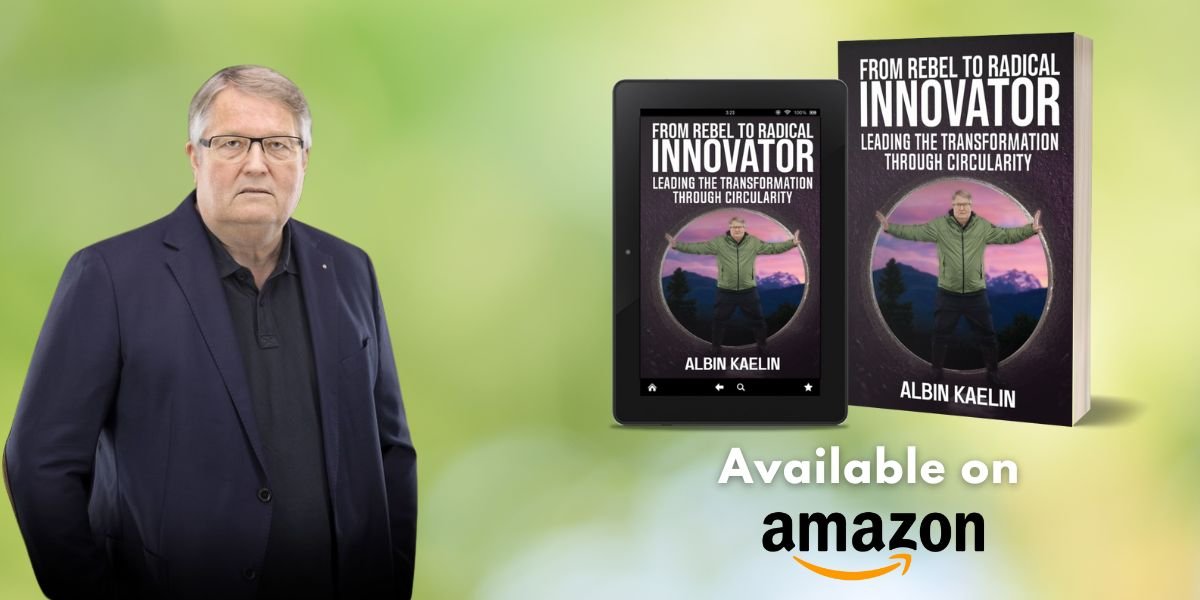
Kaelin’s book, From Rebel to Radical Innovator: Leading the Transformation Through Circularity, published in October 2024, is part memoir, part manifesto—a powerful blueprint for reshaping how we produce, consume, and design our world. With decades of work in textiles and Cradle to Cradle® (C2C) certified production, Kaelin lays out a practical and philosophical roadmap for transitioning from the outdated linear economy to one that thrives on circularity, regeneration, and shared value.
But Kaelin’s personal journey toward this vision began long before the accolades and boardrooms.
“I’m actually left-handed,” he recounts. “But when I got to school, I was forced to write with my right hand. I asked why—but I didn’t get an answer. That experience taught me not to accept anything whose sense I do not understand.”
That seemingly small childhood moment planted the seed for a lifetime of questioning systems that no longer serve us. As Kaelin puts it, “I want to shape my life so that it makes sense—for me, and for the community.” That pursuit of meaningful work led him directly into the Cradle to Cradle framework, a design philosophy that reimagines waste as a resource and calls for materials and systems that are regenerative by design.
“When I was first confronted with the concept, it just ‘made klick,’” Kaelin says. “It provided the roadmap I had been searching for.”
Kaelin would go on to apply C2C principles while leading Rohner Textil AG, where he oversaw the development of Climatex®, the first textile to receive a Cradle to Cradle certification. Since then, as CEO of epeaswitzerland GmbH, he has advised companies across sectors on how to integrate circular thinking into their operations—from product design to supply chain to end-of-life strategies.
His book offers more than 60 real-world case studies drawn from 57 companies, showing that circular transformation is not only possible—it’s already happening. Still, Kaelin is the first to admit that convincing traditional industries to take that leap is anything but easy.
“Convincing legacy industries is extremely challenging and contradictory,” he explains. “You have to speak their language. I come from that world, and I know the systems. But the key is helping individuals—managers, decision-makers—see the value in the concept based on their own principles. If it makes sense to them personally, the motivation to take a closer look follows.”
Kaelin’s approach relies on something he calls “the track of interface,” a zone of engagement where he isn’t pushing change or resisting it—but instead guiding it. “I’m neither saying yes nor no. I take responsibility and show new ways to the old system,” he says.
This method is both patient and persistent. Once someone agrees in principle with the Cradle to Cradle philosophy, Kaelin focuses on achieving a proof of concept—a project that demonstrates the viability and impact of circular design in practice. That, he says, is the tipping point.
Yet even with buy-in, change doesn’t happen overnight. According to Kaelin, the biggest obstacle isn’t technical—it’s psychological.
“The biggest challenge is balancing or visualizing risks and opportunities. It’s about building the trust to go for the adventure,” he says. “Resistance to change is natural. That’s why we emphasize ‘Building a Network of Trust.’”
This idea—trust as infrastructure—is central to Kaelin’s leadership philosophy. Circular innovation is not a solitary pursuit. It requires ecosystems of cooperation between designers, suppliers, engineers, customers, regulators, and even competitors. Through trust, stakeholders are more willing to share knowledge, test new models, and take bold steps into unfamiliar territory.
From Rebel to Radical Innovator doesn’t just explain circularity—it embodies it. The book itself is printed with safe materials and designed to be either reused or returned to the biological or technical cycle. It’s a symbolic yet practical demonstration of the very values Kaelin advocates for: transparency, accountability, and longevity.
For Kaelin, circularity is more than a business strategy—it’s a moral and ecological imperative. The traditional “take-make-waste” model, he argues, is no longer just unsustainable—it’s outdated, inefficient, and harmful by design. Cradle to Cradle offers a more intelligent approach: one where products are designed with their next life in mind, materials stay in continuous use, and business success is no longer in conflict with planetary health.
Despite the gravity of the topic, Kaelin remains optimistic. He believes that industry, when properly motivated and guided, can become a powerful driver of regeneration.
“The innovation is already here,” he says. “The question is whether we’re willing to align our systems with our values. If we are, we can go far—not fast, but far.”
In an age when sustainability talk is often diluted by greenwashing and short-term thinking, Albin Kaelin stands out as a leader who backs vision with rigor—and rebellion with results.
For those ready to lead the transition from extraction to regeneration, From Rebel to Radical Innovator is more than a book. It’s an invitation to build the world we know is possible.
To learn more about Albin Kaelin and Cradle to Cradle leadership, visit book.epeaswitzerland.com or find the book on Amazon.


