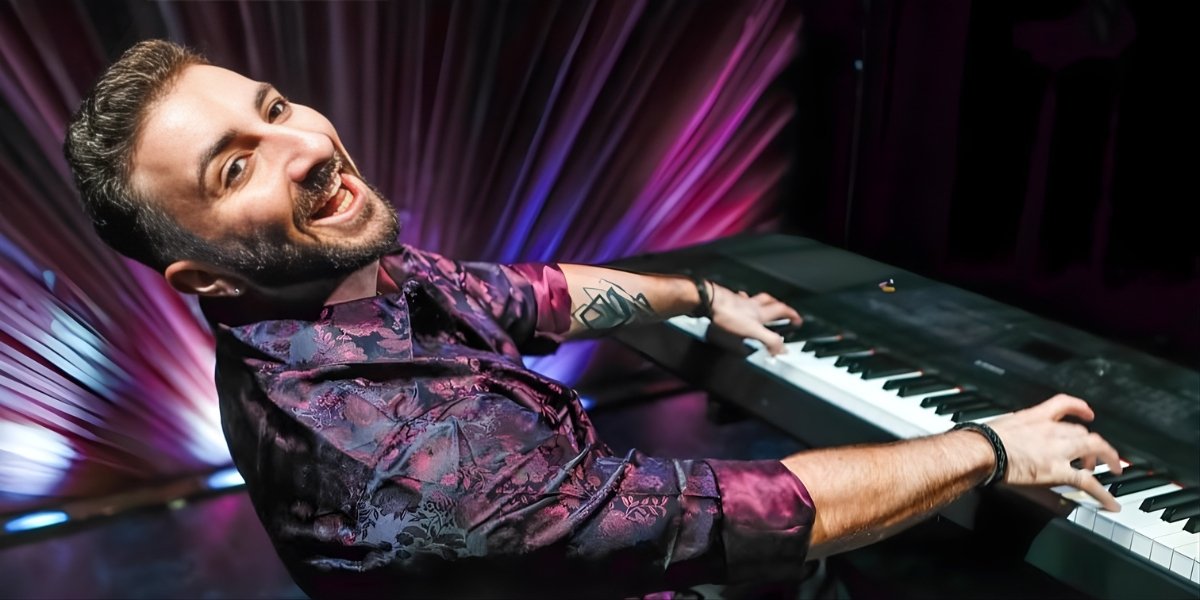


NEW YORK – The entertainment world tends to reward specialization. Actors act. Musicians play. Singers sing. Dancers dance. And most performers choose a lane early, narrowing their focus in order to stand out. Jared Svoboda has built his career by rejecting that formula entirely.
A trained actor, vocalist, pianist, and saxophonist, Svoboda has become known as a rare quadruple threat – a performer who can anchor a production musically, dramatically, and physically without relying on excessive cast size or heavy orchestration. In an era where the industry is shifting toward leaner, more efficient productions, Svoboda’s range has allowed him to thrive across Broadway national tours, television, film, and concert-style theater.
Today, he is one of four performers leading Three Pianos, a music-first theatrical production that has quickly become a standout in its category, routinely selling out and earning acclaim for its intensity, precision, and artistic depth. And for Svoboda, the show reflects the path he has been building his entire career: performance stripped down to its fundamentals – discipline, musicianship, and presence.
A Childhood Built Around Music and Craft
Svoboda’s foundation wasn’t created by accident. He was raised in a homeschooling environment where music was central to academic life. His father, Dr. Scott Svoboda, holds a Doctorate in Musical Arts, and the household treated musical literacy as essential rather than optional. Piano was the starting point, taught with an emphasis on theory and structure rather than rote memorization. From there, he expanded into voice and later dance.
This early immersion carried a dual impact. It gave him the technical fluency to become a genuine musician, not just a performer who dabbles in instruments. And it trained his ear at a level that continues to influence his acting and stage work today – particularly timing, phrasing, breathing patterns, and emotional cadence.
New York Training and the Dual-Track Career
After high school, Svoboda moved to New York to train at New York University’s Tisch School of the Arts, where he focused on musical theater performance. Tisch provided the stage emphasis, while Stonestreet Studios provided the screen emphasis. Unlike many performers who specialize and expand later, Svoboda pursued both at once. It made him adaptable at the start of his career, able to shift between theatrical auditions, commercial shoots, and music-focused roles with equal discipline.
Those early years included regional productions and touring shows, each one reinforcing the stamina required for long-running performances. Touring is a pressure cooker: new cities weekly, adjusted stage conditions, variable acoustics, and the demand for consistency each night. Svoboda learned to deliver the same level of performance whether playing to a packed house or a challenging venue – a skill that has become one of his signatures.
The Stage: A Resume Built on Range and Endurance
Svoboda’s theatrical credits reflect a performer unafraid of stylistic diversity. He has appeared in productions of:
- Newsies
• Jersey Boys
• Fiddler on the Roof
These roles required not only acting and singing but also physical endurance and musical discipline. That foundation led him to one of his most demanding gigs: a residency in Las Vegas for Jim Steinman’s Bat Out of Hell at the Paris Hotel and Casino. The production fused rock-opera intensity with musical theater precision. Show days often felt like a blend of concert performance and athletic training, combining choreography with vocal endurance.
From Vegas, he transitioned to the national tour of Dear Evan Hansen, serving as understudy for Larry Murphy. The role demanded emotional steadiness and restraint – a contrast to the high-voltage aesthetic of Bat Out of Hell. Yet Svoboda shifted seamlessly, highlighting the breadth of his acting range.
Screen Work: Translating Stage Discipline to Camera
Though Svoboda is best known for his stage versatility, his screen work has strengthened his reputation for adaptability. His most widely recognized appearance came through The Story of God with Morgan Freeman, where he portrayed Jesus Christ in the National Geographic series.
The performance required a balance of stillness and sensitivity – skills rarely tested in theater environments where larger expression is the norm. Svoboda approached the role with historical awareness and emotional nuance, producing a grounded interpretation that aligned with the series’s educational style.
He later added credits in The Troupe, Buried in the Backyard, and several independent film projects, giving him a foothold across multiple formats rather than being relegated exclusively to musical theater.
Musicianship: The Skill That Separates Him
In modern entertainment, performers who can act, sing, and play live instruments are becoming increasingly valuable. Productions are shrinking. Budgets are recalibrating. Shows are leaning toward intimate, immersive experiences that rely on fewer cast members who can do more.
Svoboda is built for this new model.
His ability to play both piano and saxophone at a professional level shifts entire production structures. He can perform live underscoring, carry melodic lines, or support transitions without requiring separate instrumentalists, dancers, or ensemble casts. This gives directors and producers greater creative flexibility — and gives audiences a more dynamic performance.
Three Pianos: The Project That Defines His Approach
The most concentrated example of Svoboda’s versatility is Three Pianos, a show powered by only four performers who sing, play piano, play auxiliary instruments, and deliver narrative storytelling throughout the entire production.
There is no ensemble. No safety net. Every performer carries a quarter of the show’s runtime.
For Svoboda, the show is both a challenge and a perfect fit. He contributes as a vocalist, pianist, and central storytelling presence, helping to shape a production that feels more like an immersive concert than traditional musical theater.
Audience response reinforces the impact. Shows routinely sell out, with attendees praising the show’s intimacy, technical precision, and emotional punch. Industry observers point to Three Pianos as an example of where live theater is heading – smaller, musician-driven, performance-forward.
A Performer Built for the Next Era of Entertainment
As he continues to build his career, one thing is clear: Svoboda is not defined by a single lane. He is defined by range. His ability to move between musical theater, concert performance, screen acting, and movement-driven stage work places him in a rare tier of multidimensional performers equipped for the future of entertainment.
With more productions seeking artists who can do it all, Jared Svoboda stands out not because he chose a niche, but because he mastered several.
For more information, visit www.jaredsvoboda.com