
By: Emily Carter
Most conversations about religion drift. They circle big questions, lean on tradition, or settle into personal belief. What they rarely do is submit themselves to pressure.
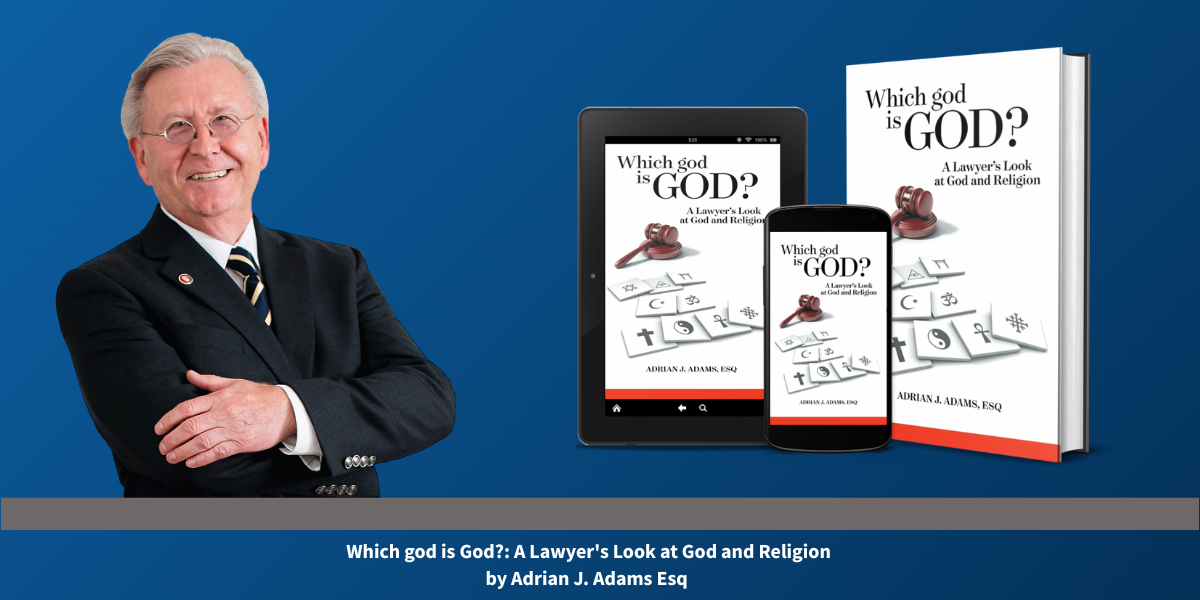
That’s where Which god is God? takes a different route.
Adrian J. Adams does not approach faith like a theologian or a pastor. He approaches it like someone preparing for a trial. Not metaphorically. Literally. Claims are examined. Sources are questioned. Assumptions are pushed until they either hold or collapse.
It sounds clinical, but the book’s origin is surprisingly human.
A Lunch Conversation That Wouldn’t Let Go
The entire project started with a simple question across a table.
A law partner asked Adrian whether God exists. Not as a philosophical exercise, but as something he wanted a defensible answer to. Once that question moved from abstract to personal, it triggered a second one that is harder to ignore.
If God exists, which God are we talking about?
That question tends to get brushed aside in everyday conversation. Too complex. Too sensitive. Too easy to turn into a stalemate. But for someone trained in law, that kind of ambiguity is not acceptable. Competing claims demand evaluation.
What began as informal discussions turned into a more structured process. Then into a memo. Then, almost inevitably, into a full book.
The shift happened when Adrian realized something simple but uncomfortable. If one person wanted answers that could stand up to scrutiny, there were probably many others asking the same thing quietly.
Putting Religion on the Stand
Most books about faith ask readers to reflect. This one asks them to examine.
Adrian leans on the logic of the courtroom, where truth is not assumed but tested. In that setting, every claim carries a burden. You do not just say something is true. You show why it should be believed.
That framework changes the tone immediately.
Instead of asking what feels right, the conversation moves toward what can be supported. Where did this belief come from? Who recorded it? How consistent is it? Does it contradict itself? Can it be verified or at least reasonably trusted?
It strips away much of the comfort, but it also brings clarity.
Evidence, But Not the Kind People Expect
The word “evidence” usually evokes a narrow definition. Documents. Witnesses. Physical proof.
Adrian expands that idea without abandoning structure.
He starts with science, not as an enemy of faith, but as a foundation. Questions about the origin of the universe, the complexity of biological systems, and the apparent order embedded in nature are treated as entry points. Not conclusions, but signals that something requires explanation.
From there, the focus shifts.
If a religion claims to speak for God, the first question is not whether it sounds compelling. It is where the information comes from. What is the source? Is it consistent? Has it been preserved accurately? Does it align with other observable truths or collapse under pressure?
In a courtroom, unreliable sources are quickly dismissed. Adrian applies the same instinct here.
That move alone reframes the entire conversation.
Testing Belief Instead of Protecting It
One of the more interesting undercurrents in Adrian’s approach is that it is not just outward-facing.
He admits that his legal background forced him to test his own beliefs. Not gently. Not selectively. The same standards that applied to other systems had to apply to his own.
That kind of self-examination tends to either weaken belief or refine it.
In his case, it strengthened it.
Not because it removed all doubt, but because it forced his beliefs to pass through a filter that most people never apply. It is one thing to believe something because you were raised with it. It is another to believe it after trying to dismantle it and failing.
That difference shows up in how he writes.
Why This Approach Feels Uncomfortable
There is a reason most discussions about religion avoid this kind of structure.
It introduces friction.
When you move from personal conviction to shared evaluation, you risk conflict. Different belief systems are no longer allowed to coexist quietly. They are compared. Measured. Sometimes exposed.
That process can feel cold. It can also feel reductive, especially for readers who see faith as something deeply personal and not meant to be dissected.
And to be fair, there is a tradeoff.
Reducing religion to evidence and argument can miss parts of the human experience that do not translate easily into logic. Community, tradition, emotional resonance. These are harder to quantify but still matter.
Adrian does not ignore that tension, but he chooses a side.
If truth exists, he argues, it should be able to withstand examination.
The Question Behind the Question
At the surface level, the book asks which god is truly God.
Underneath that, it is asking something else.
Are we willing to challenge what we believe, or do we prefer to protect it?
That is not a theological question. It is a psychological one.
Most people inherit their beliefs. They do not audit them. They do not test their origins or question their internal consistency. They simply operate within them.
Adrian’s approach disrupts that pattern.
Not by telling readers what to believe, but by changing how they evaluate belief itself.
A Different Kind of Reader
This is not a book for someone looking for comfort.
It is for someone who feels a bit uneasy with easy answers. Someone who has noticed contradictions but has not found a structured way to explore them. Someone who is less interested in being reassured and more interested in being convinced.
That is a smaller audience, but a very specific one.
And for that audience, the legal framing is not a gimmick. It is the entire point.
Where It Leaves the Conversation
There is no neat resolution here.
Applying courtroom logic to religion does not eliminate disagreement. It sharpens it. It forces clarity where there was once ambiguity. It pushes readers to either defend their beliefs more rigorously or reconsider them entirely.
For some, that will feel liberating.
For others, it will feel disruptive.
Either way, it is difficult to walk away unchanged.
And maybe that is the real outcome Adrian was aiming for all along.
For more information about Adrian J. Adams and his book, visit the official Which god is God? Website or find his book on Amazon.