
By: M.L Woolgar
This Story Does Not Begin With Strength
Some people expect stories like this to open with courage. Or determination. Or some defining moment where everything changes.
Eugen’s story does not start there.
It starts with confusion.
In Forward—Giving Up is Not an Option, what stands out is not a dramatic pivot, but a slow realization. When he was diagnosed with multiple sclerosis in the early nineties, it did not feel like a life breaking moment. There was no flood of information, no immediate sense of permanence.
The symptoms came, then eased. Treatment worked. Life continued.
At first, nothing really forced him to rethink anything.
And that is what makes what comes next hit harder.
When Change Does Not Announce Itself
The real shift did not come with the diagnosis. It came later, when the things he loved started slipping away.
Not all at once. Gradually.
For Eugen, that loss was deeply physical. Working outdoors. Being in the fields. Driving a tractor. Building something real with his hands.
When those abilities faded, it was not just a lifestyle change. It was a quiet identity shift. The kind that does not come with a clear replacement.
Office work filled the gap, but it did not replace the feeling.
There is a difference between adapting and choosing.
He adapted. But something stayed unsettled.
The Moment Everything Became Real
Then came 2011.
An accident forced a level of reality that could not be postponed or softened. A wheelchair was no longer theoretical. It was immediate.
That was the shock.
And it is important to say that clearly, because too many stories skip over that part. They jump straight to resilience.
Eugen does not.
He writes about the hesitation, the fear, the sense of exposure. Not just physically, but emotionally. Even finishing the book itself brought that feeling back. The moment before publishing, where everything becomes visible, almost stopped him.
That hesitation matters. It keeps the story grounded.
Movement Becomes Something You Design
What follows is not a comeback. It is more interesting than that.
Eugen begins to rebuild mobility, not by trying to return to what was, but by experimenting with what is possible now.
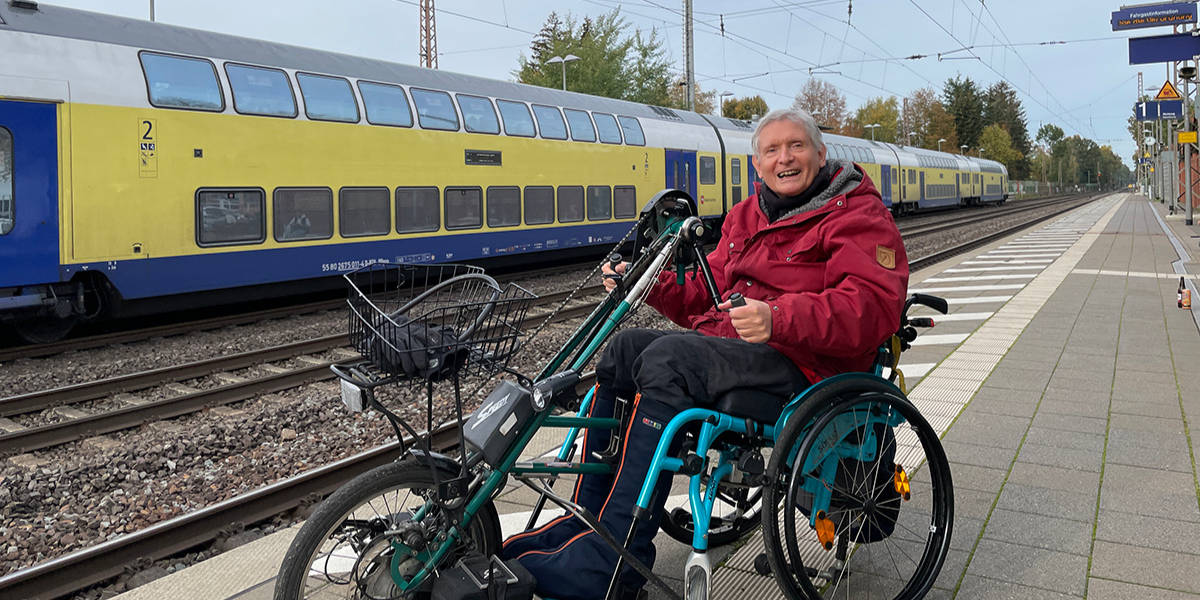
The wheelchair hand bike becomes a turning point, not because it solves everything, but because it reintroduces something essential. Movement with intention.
This is where the tone shifts.
Not into motivation, but into problem solving.
How do you move through a world that was not built with you in mind?
How do you regain independence when the usual paths are no longer available?
The answers are not immediate. They are built.
The Mindset That Actually Changes Things
“Giving up is not an option” sounds like a phrase people repeat without thinking.
For Eugen, it is not abstract.
It shows up in repetition. Trying something again when it fails. Looking for alternatives instead of stopping. Refusing to treat obstacles as fixed endpoints.
Over time, something subtle happens.
Activity builds strength. Strength builds confidence. Confidence creates more activity.
It becomes a loop.
And once that loop starts, problems begin to look different. Not smaller, but more workable.
The Part Most People Never See
One of the strongest elements in the book is not emotional. It is observational.
Eugen highlights something most people move past without noticing. How environments quietly exclude.
A staircase without a ramp. A broken elevator. A narrow entrance.
For someone walking, these are minor inconveniences. For someone in a wheelchair, they can completely shut down access.
These moments are not framed as complaints. They are simply reality.
But they reveal something deeper.
Independence is not just personal. It is structural.
What Resilience Actually Looks Like
It is easy to label this story as inspiring and leave it there.
That would flatten it.
What Eugen shows is that resilience is not a personality trait you either have or do not have. It is something you build through repetition.
Through small adjustments.
Through choosing to move forward even when progress feels limited.
There are moments of frustration. Moments of doubt. Moments where nothing seems to improve.
But there is also persistence.
And over time, that persistence compounds.
Letting Go Without Losing Direction
One of the hardest parts of Eugen’s journey is something people rarely talk about openly.
Letting go of what you once loved.
Not replacing it. Not rebranding it. Letting it go.
For him, that meant accepting that working the land in the same way was no longer possible.
That kind of loss does not resolve neatly.
But what he does instead is redirect.
He finds new ways to engage with life. New systems. New routines. New forms of movement.
It is not the same life.
But it is still his.
A Different Definition of Control
What makes this story stick is not the adversity. It is how control gets redefined.
Eugen does not get his old life back. That is not the goal.
Instead, he builds something that works within his current reality.
That shift is important.
Because it moves the focus away from recovery as returning to the past, and toward construction. Building something that functions now.
Not perfectly. Not effortlessly.
But intentionally.
Why This Story Lands Beyond the Obvious
On the surface, this is a story about living with physical limitations.
Underneath, it is about something broader.
What do you do when the system you relied on stops working?
How do you rebuild when your usual tools are gone?
How do you move forward when forward no longer looks familiar?
Eugen does not offer clean answers.
He offers something more useful.
A way of thinking that refuses to stop at the first obstacle.
And a reminder that progress is not always visible at the beginning.
Sometimes, it is just the decision to keep going.
For more information, visit his official website: https://www.eugenehrenberg.com/ or find his book on Amazon.