
By: Fred Davison
Some songs announce themselves with volume. Others earn their place through patience. Harry Kappen’s “Distant Shore” belongs firmly in the second camp, a thoughtful, beautifully realized piece of atmospheric rock that reminds you how powerful restraint can be when it’s backed by conviction.
For years, Kappen has quietly built one of the more intriguing independent catalogs in contemporary rock. The Dutch-born singer-songwriter, producer, and multi-instrumentalist has never seemed interested in chasing trends or fitting neatly into a single genre. Instead, he has consistently followed ideas wherever they lead him, drawing from classic rock, progressive pop, singer-songwriter traditions, and ambient textures to create music that feels deeply personal while remaining remarkably outward-looking.
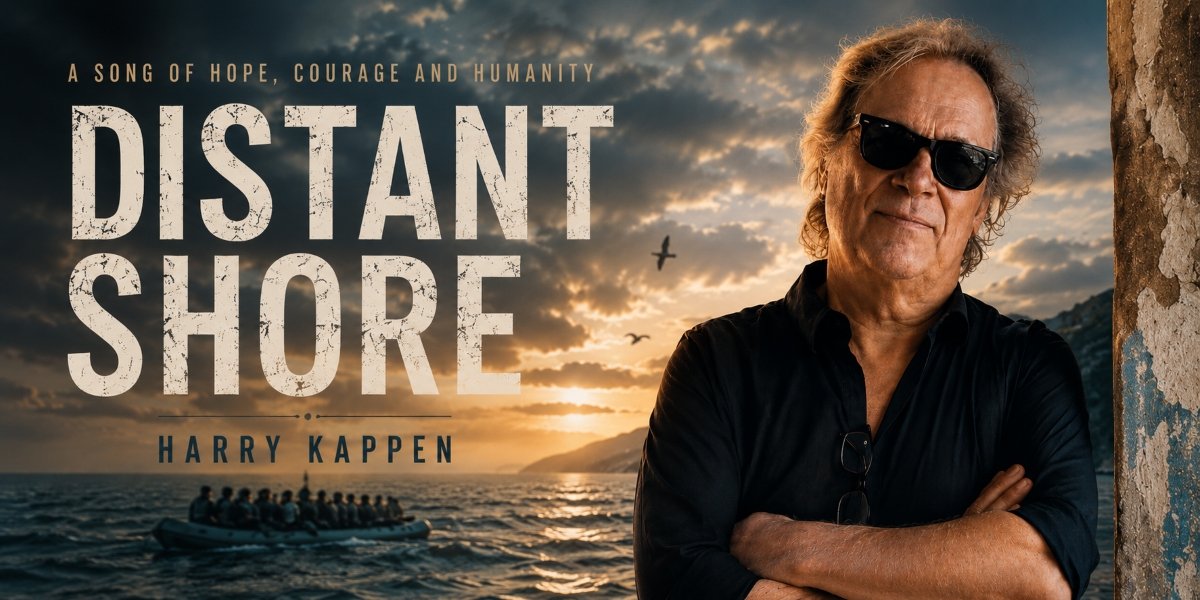
“Distant Shore,” one of the centerpiece tracks from After the Crossing, may be the clearest expression yet of that artistic philosophy.
Inspired by the stories of refugees risking everything to escape war, poverty, and persecution, the song was born from Kappen’s own relocation from the Netherlands to Mexico. Yet what gives the record its emotional credibility is the humility with which he approaches the subject. Rather than comparing his own move to the experiences of displaced people, Kappen recognizes the profound difference between choosing to cross a border and being forced to cross one.
That awareness shapes every moment of the song.
The opening lyric is quietly devastating:
“I kiss the door I can’t replace…”
It’s an image that immediately collapses the distance between listener and subject. Before politics, before borders, before ideology, there’s simply a person saying goodbye to home. That’s where Kappen chooses to begin, not with commentary but with memory.
As the narrative unfolds, the details become increasingly vivid: overcrowded trucks, endless nights, crashing waves, whispered prayers. Yet the song never slips into melodrama. Kappen understands that specificity carries its own emotional force. A single suitcase tells us more than a speech ever could.
Musically, “Distant Shore” unfolds with remarkable confidence. Kappen wrote, performed, arranged, and produced the track himself, and there’s an uncommon unity to the recording. Every instrument seems to occupy exactly the right emotional space.
The most immediately recognizable sonic signature comes from the mellotron, whose ghostly textures inevitably recall David Bowie’s “Space Oddity.” Kappen has openly cited Bowie as an inspiration, but this isn’t homage for nostalgia’s sake. Instead, he borrows the sense of suspended isolation that made Bowie’s classic so unforgettable and redirects it toward another kind of journey, one measured not in miles above Earth but in impossible miles across land and sea.
The production breathes.
Keyboards drift like distant weather systems while guitars shimmer just beneath the surface. The rhythm section never forces momentum; it simply keeps moving forward with quiet determination, much like the people whose stories inspired the song. Even the instrumental passages feel purposeful, creating emotional space rather than filling every available second with sound.
Kappen’s vocal performance mirrors that same philosophy.
He doesn’t oversell the lyrics. There’s no theatrical anguish, no attempt to wring emotion from exaggerated phrasing. Instead, he sings with calm sincerity, allowing the weight of the words to emerge naturally. It’s the voice of someone observing carefully rather than performing dramatically.
That subtlety becomes especially effective in the chorus.
“Where is that distant shore…”
The question functions on several levels simultaneously. It’s about physical safety, certainly. But it’s also about belonging, peace, redemption, and the universal desire to find solid ground after uncertainty. Kappen wisely refuses to define the answer too narrowly. The distant shore remains just over the horizon, allowing each listener to imagine what it represents personally.
What separates “Distant Shore” from many socially conscious songs is its refusal to simplify its subject. There’s no tidy resolution waiting in the final chorus. No triumphant declaration that everything will be okay. Hope exists, but it remains fragile.
That honesty gives the song its staying power.
It’s impossible not to hear Kappen’s background in music therapy reflected throughout the recording. After spending decades working with young people and families, he has developed an instinct for listening that informs his songwriting. “Distant Shore” never assumes ownership of another person’s experience. Instead, it creates space for empathy, inviting listeners to imagine lives very different from their own.
That generosity extends across After the Crossing as a whole. Recorded after Kappen’s move to Mexico, the album feels less concerned with documenting personal reinvention than exploring the broader idea of transition itself, what we carry with us, what we leave behind, and how movement changes our understanding of home.
Rock music has always been at its strongest when it balances individual expression with a wider sense of social awareness. From the folk revival through the singer-songwriter era and into modern independent music, the artists who endure are often those who understand that personal stories can illuminate larger truths without sacrificing either.
Harry Kappen has written exactly that kind of song.
“Distant Shore” doesn’t rely on spectacle or grandiosity to make its point. Instead, it trusts melody, atmosphere, and carefully chosen words to do what the best songs have always done: remind us that every headline is ultimately someone’s life.
In an era when so much music races toward immediate impact, Harry Kappen has created something far rarer: a song that lingers, grows deeper with repeated listening, and quietly insists that compassion remains one of art’s greatest strengths.