
By: Kate Sarmiento
Not many people decide to care about where their beef comes from on a random Tuesday afternoon. It usually starts with something small, a comment from a friend who “switched to grassfed,” a random rabbit hole about antibiotics in conventional meat, a documentary watched mostly by accident. And then something shifts. Not dramatically, not overnight, but the next time you’re standing in the meat section of a grocery store, you’re reading labels differently than you were the last time. That is the kind of moment Foxhollow Farm in Crestwood, Kentucky, has been building toward for nearly two decades. Their 1,300-acre Biodynamic farm exists on a pretty specific bet: that eventually, people may stop settling for beef they know little about and start caring enough to find an alternative.
It is worth noting just how much has changed in the broader food conversation over the last ten years alone. There is now a category of consumers, big and growing, who read sourcing information the same way they read ingredient lists. Nearly 70% of U.S. consumers say animal welfare influences their meat purchases (Source: NSF, 2024). That suggests this is not a fringe number. That is many people, at least in what they say they value. Whether their shopping cart reflects that is a different conversation, but the fact that transparency has become a genuine selling point rather than a niche concern suggests something may be shifting.
The Thing People May Overlook About Food Identity
At some point, food stopped being purely about hunger or even pleasure and started functioning as a kind of personal statement. Which sounds pretentious when said directly, but think about what happens when someone you know announces they only buy local meat now, or starts talking about their CSA share, or brings up regenerative agriculture at dinner unprompted. You form a picture of them pretty quickly. That picture, fair or not, is built on the choices they make about food. Consumer behavior researchers have a term for this, “value-expressive consumption,” which describes how people use purchases to signal who they are and what they stand for (Source: World Economic Forum, 2023). Food is one of the categories where it commonly shows up.
Beef especially carries a lot of that weight. It is not like switching shampoo brands. Choosing where your beef comes from drags in questions about land use, animal treatment, environmental impact, farm economics, and what version of the food system someone is quietly agreeing to support every time they check out. Those questions did not used to come up at the grocery store. Now they can, even if plenty of people are still pushing past them without much pause.
The growth of direct-to-consumer farms, Biodynamic certification, grass-fed and grass-finished labeling, and regenerative ag as a marketing category, none of that appears coincidental. About 65% of American consumers say they try to buy sustainably produced food (Source: Food Business News, 2023), and younger shoppers specifically are more likely than previous generations to actively research food sourcing before making a purchase (Source: McKinsey, 2023). What this mostly tells us is that the demand for something more transparent than a generic “natural” claim on the front of a package may not be going away. If anything, consumers may be getting more attentive to when a label is doing marketing work instead of information work, and may be getting less patient with the difference.
There is a specific frustration that builds when you care about these things but keep running into vague, unverifiable claims. “Humanely raised.” “Responsibly sourced.” Technically, those phrases could mean almost anything, and often they do. The farms that are trying to build trust right now are the ones that have something certifiable to point to, that can name their practices by actual name, whose certifications require third-party verification rather than self-report. That may be a shorter list than people assume.
What You May Understand When You Know the Farm
Here is something that sounds obvious but plays out in an interesting way: knowing where food comes from can change how people experience it. Research suggests this can happen in a measurable way. Research on food provenance consistently finds that a traceable, named origin may increase perceived quality and the willingness to pay more, even when the product itself is identical (Source: Science Direct, 2024). The beef may not change. The relationship to it can, and that relationship may matter to the actual eating experience.
Foxhollow Farm is built on this principle, though Maggie Keith, the fourth-generation steward and CEO who has been running the operation since 2006, would probably describe it in plainer terms. She is not selling mystery. She is selling beef that comes from a specific place, with specific practices, from a farm she lives on with her family. The Demeter Certified Biodynamic designation and the Level 5 Regenified certification her farm holds are not branding exercises. They require third-party verification of how the whole farm ecosystem is managed, land, animals, plants, water, and the relationships between all of them. That is a meaningfully different standard than much of what gets called “sustainable” in conventional retail.
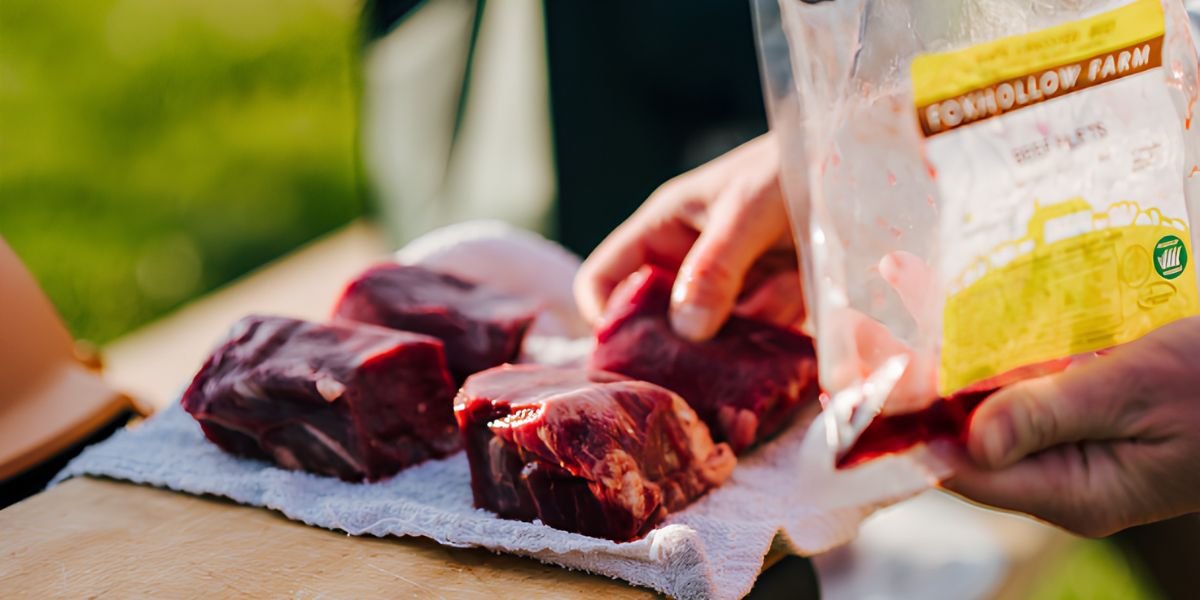
When someone orders grass-fed beef from Foxhollow, they are getting a relatively direct chain of custody. There is no long commodity distribution route, no anonymous processor in the middle, no guesswork about what “grass-finished” means on this particular package. The farm ships regionally along the East Coast, keeps the supply chain deliberately short, and runs an on-farm market at the Crestwood property, where people can show up in person and see what they are buying into. That last part may matter more than it might seem. There is a psychological weight to physically being somewhere, walking around a working farm, watching how the land is managed. It can be harder to be cynical about sourcing when you have stood on the land yourself.
The direct-to-consumer model can also do something that traditional retail may not do as directly: it can help close the distance between producer and eater. Conventional supply chains involve so many layers, processors, distributors, brokers, and retailers that by the time beef reaches a store shelf, the farm is essentially invisible. That invisibility is not neutral. It is the condition that can make it easy not to ask questions. Foxhollow’s approach is built on the premise that if people can see where their food comes from, they may keep choosing it, and they may care about what happens to the farm.
The Purchase That May Reach Beyond Your Kitchen
One of the things that surprises people when they start paying closer attention to food sourcing is realizing how non-isolated their individual choices can be. A grassfed beef subscription is not necessarily just a personal health decision. It is financial support for a specific farming model, a specific relationship to land, a specific economic bet that regenerative agriculture may work at scale. Each of those things matters well beyond whoever is eating the steak.
Regenerative farming, which is what Foxhollow has been doing long before the term became a marketing category, is about actively rebuilding soil health, improving biodiversity, and managing land in ways that aim to restore rather than deplete. Managed cattle grazing is part of that system when done right, not the environmental villain it gets cast as in simplified narratives. Healthy, well-managed pasture land may sequester carbon (Source: Nature, 2015), and the long-term soil restoration that can come from biodynamic practices may accumulate over years and decades, not quarters. That can depend on farms that are economically viable enough to stay in it for the long haul.
Which is where the consumer relationship loops back around. Maggie Keith has been direct about this: for the next generation to choose farming as a real career, farming needs to work as a business. The model Foxhollow is building in Oldham County, Kentucky, a regenerative farm that is economically self-sustaining and directly connected to its customer base, is a demonstration of what that can look like. It is nearly 20 years in the making, and it is still operating, which may be one reason supporters point to it as a working example.
So the person who decides to order a box of Foxhollow grassfed beef, or drive out to the farm market on a Saturday, or bring it up with a friend who has been asking about other meat options, may be doing something that extends beyond their own freezer. They are putting purchasing power behind a food system that operates on different terms than the industrial default. Whether or not they are thinking about it in those terms when they click “add to cart” is almost beside the point.
Ready to Know Where Your Beef Comes From?
If any of this has landed somewhere familiar, maybe you have been thinking about changing how you buy meat, or you have been skeptical of grocery store claims for a while now, Foxhollow Farm may be worth considering. Their beef is 100% grassfed and grass-finished, with no grain finishing, raised on a Demeter Certified Biodynamic farm that has been doing this work since 2006. The Level 5 Regenified certification is a standard in regenerative agriculture, and it requires verification, not just a mission statement.
They ship regionally to the East Coast, which is designed to keep the supply chain shorter. The on-farm Foxhollow Market is open daily if you happen to be in or around Crestwood, Kentucky, and want to see the operation in person. There are also subscription options that make their beef a regular part of the routine rather than a one-time experiment.
The food system may change one sourcing choice at a time. That is the idea behind the model. Head to foxhollow.com and find out what a working farm looks like.