
By: Alexandra Quinn
New York City knows something about fireworks.
Every summer, millions of people squeeze onto rooftops, waterfront parks and whatever patch of pavement offers a glimpse of the sky, waiting for Manhattan to temporarily surrender its monopoly on illumination. Fireworks explode above the rivers while car horns provide percussion below. It’s excessive, chaotic, romantic and completely ridiculous.
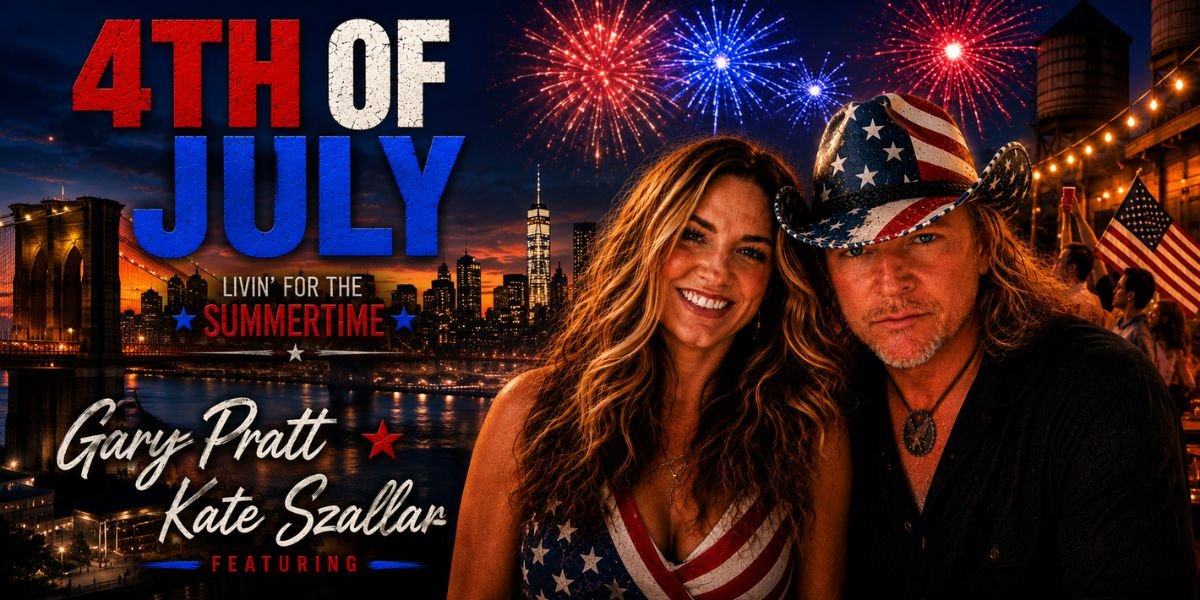
Which makes New York an unexpectedly appropriate place to hear Gary Pratt’s “4th of July.”
The country singer’s collaboration with Kate Szallar isn’t actually about Independence Day. There are no parades, flags waving from porches or coolers packed for a holiday barbecue. Pratt takes the spectacle of July Fourth and reduces it to its emotional essence: anticipation, heat and the thrill of something exploding.
His fireworks happen between two people.
Even better, they happen in February.
That’s where the song gets interesting from a New York perspective. Anyone who’s survived February in this city understands the significance of finding something that can make winter disappear. February here is dirty snow piled against curbs, black coats disappearing into subway entrances and daylight abandoning Midtown before anybody has finished work.
Pratt opens with an ordinary February night and immediately heats it up.
A slow kiss changes the weather. Two people staying indoors discover they don’t need summer because they’ve manufactured their own version.
New Yorkers can appreciate the efficiency.
The song’s chorus makes no attempt at subtlety. Pratt declares that the relationship has him feeling like the Fourth of July, complete with a “boom boom boom” hook representing fireworks going off around the couple.
On paper, that’s dangerously close to corny.
Through the speakers, it’s irresistible.
Pratt understands that country music, like New York, occasionally benefits from refusing to apologize for being loud. The chorus isn’t interested in clever ambiguity. It’s built to be remembered after one listen, shouted after two and probably sung badly after three drinks.
Kate Szallar helps turn the premise into something more convincing. Her presence means this isn’t merely Pratt announcing how spectacular his romantic evening has become. There’s another voice in the room.
The chemistry feels mutual.
That matters because “4th of July” isn’t really a seduction song. It’s a celebration of already having arrived somewhere two people want to stay.
There’s something almost anti-New York about that.
This city is perpetually obsessed with what’s next: the next restaurant, neighborhood, apartment, job, train, relationship. Pratt writes about staying exactly where you are. The song even makes the couch sound preferable to going outside.
Try telling that to somebody paying $4,500 a month for a one-bedroom.
Still, the sentiment translates.
Because beneath all the country imagery is an idea New York understands perfectly: privacy is luxurious. In a city where eight million people seem determined to participate in every moment of your existence, finding one person who makes the rest of the population disappear can feel miraculous.
Producer Adam Ernst gives that intimacy enough scale to carry the record. A musician whose credits include work on recordings by Bailey Zimmerman, Mickey Guyton and Chase Matthew, Ernst plays every instrument on “4th of July.”
The result doesn’t sound like a one-man-band stunt. It sounds remarkably cohesive.
The guitars have enough muscle to keep the track rooted in contemporary country, while the rhythm gives Pratt and Szallar room to sell the hook. Ernst wisely avoids overcrowding the arrangement. There’s polish here, certainly, but not the antiseptic shine that can make modern country feel like it was assembled in a marketing conference.
The song still has fingerprints on it.
That matters in New York, where authenticity remains currency even if everybody disagrees about what authenticity actually means.
And despite its country DNA, “4th of July” isn’t geographically trapped.
You don’t need a pickup truck.
You don’t need a porch.
You don’t even need a backyard.
A Brooklyn rooftop will work.
So will a Queens apartment with the windows open, a Staten Island deck, a Bronx fire escape or a walk along the Hudson while fireworks illuminate buildings that usually provide their own light show.
Pratt’s metaphor survives because fireworks belong to everybody.
The cleverest decision remains setting the song in February. That one detail frees “4th of July” from becoming another seasonal novelty. The holiday is merely shorthand for a feeling. Pratt is arguing that the right person can turn February 12 into July 4 without leaving the couch.
That’s considerably more interesting than another song about summer.
There’s also something refreshing about hearing a record this unashamedly happy.
New York specializes in skepticism. Tell somebody you’re in love and they’ll ask what neighborhood you live in, how much you’re paying in rent, and whether the relationship is worth changing subway lines.
Pratt doesn’t entertain those complications.
Two people are together.
They’re attracted to each other.
They’re having a spectacular night.
That’s the plot.
Sometimes three minutes of music doesn’t need to solve existential loneliness. Sometimes it just needs to make you grin.
By the closing repetitions of “better and better than the Fourth of July,” the hook has done its job. Pratt and Szallar have taken America’s biggest summer celebration and transformed it into something smaller, warmer and more private.
And maybe that’s where New York and country music unexpectedly meet.
Both understand that enormous things can happen in very small rooms.
Outside, eight million people can keep rushing somewhere.
Inside, Gary Pratt’s fireworks are already going off.