
By Adrian Locke
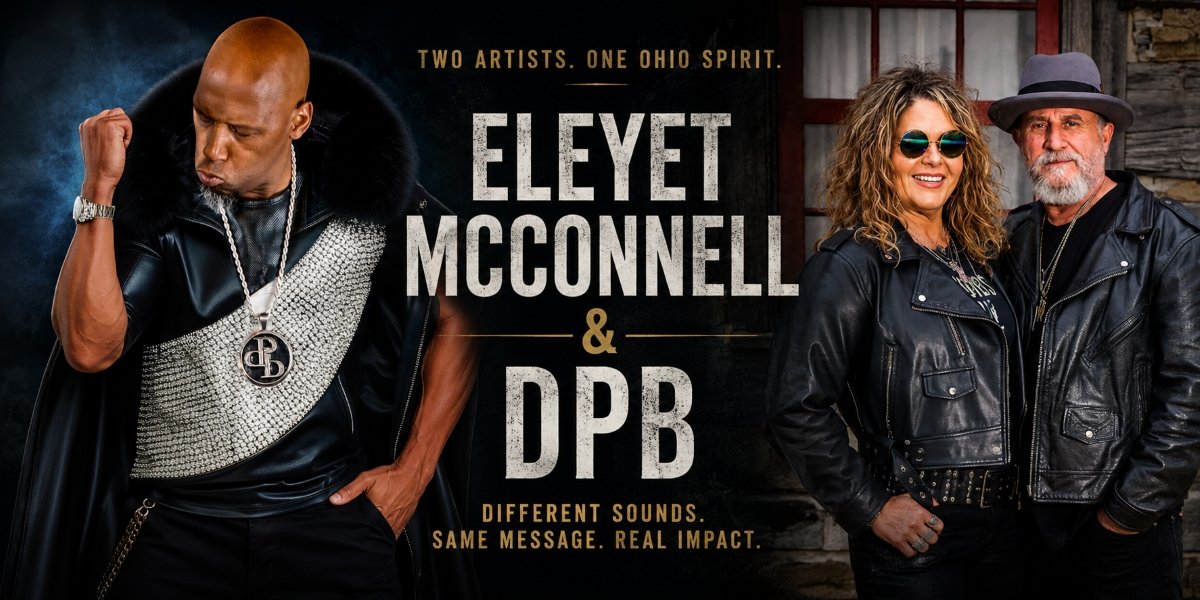
There is a tendency to think of independent music as fragmented, a thousand isolated voices competing for attention in an increasingly crowded digital landscape. Yet every so often, two artists emerge from the same place with vastly different sounds, proving that geography isn’t about genre. It’s about perspective. Ohio has long been fertile ground for musicians who refuse to color inside the lines, and today, few embody that spirit more convincingly than rock duo Eleyet McConnell and Christian hip-hop pioneer DPB.
On paper, they couldn’t appear more different.
Eleyet McConnell build sweeping rock anthems rooted in the traditions of Heart, Led Zeppelin, and Pink Floyd. DPB, David Paul Brooks, constructs faith-driven hip-hop that merges contemporary production with messages of perseverance, redemption, and hope. One leans on soaring guitars and emotionally charged vocals. The other rides rhythmic cadences and lyrical precision.
Listen closely, however, and the similarities become impossible to ignore.
Both artists understand that songs aren’t simply entertainment. They’re conversations.
That commitment is evident throughout Eleyet McConnell’s latest work, particularly the emotionally resonant single “Your Eyes.” The song strips away modern pop excess in favor of timeless craftsmanship, allowing Angie McConnell’s commanding vocal performance to become its emotional center. She sings not with theatrical flourish but with conviction, treating every lyric as lived experience rather than performance.
It’s the kind of vocal that refuses shortcuts.
Chris McConnell’s songwriting follows the same philosophy. Rather than chasing fleeting trends, he builds songs around melody, narrative, and emotional honesty. Together, the husband-and-wife duo have created a catalog that embraces classic rock’s expansive ambitions while remaining grounded in deeply personal storytelling. Their album The Journey isn’t merely a collection of songs; it’s a reflection on resilience, relationships, and the complicated grace that accompanies survival.
Recognition has followed naturally. The duo recently earned seven 2026 Josie Music Awards nominations, spanning songwriting, performance, music video, and musicianship. The nominations aren’t simply acknowledgments of technical achievement. They reflect years spent refining a creative partnership built on trust, both onstage and off.
DPB’s journey follows a different musical path but arrives at remarkably similar emotional destinations.
For more than three decades, David Paul Brooks has quietly become one of Christian hip-hop’s most consistent voices, using rap not as an instrument of confrontation but as a vehicle for encouragement. His newest single, “God Mode,” continues that mission, transforming contemporary language into a declaration of spiritual confidence rooted in faith rather than ego.
Where many motivational songs mistake confidence for invincibility, DPB presents strength as something borrowed from belief. His verses move with the cadence of someone who has weathered setbacks and emerged with perspective instead of bitterness. The production is modern and energetic, but its purpose remains clear: every beat exists to amplify the message rather than distract from it.
That clarity has helped define his career.
Long before faith-based hip-hop became widely accepted within mainstream Christian music, DPB was building bridges between genres, collaborating with respected artists while remaining steadfast in his commitment to positive storytelling. His work has consistently demonstrated that commercial appeal and spiritual conviction are not mutually exclusive ideas.
What ultimately links DPB with Eleyet McConnell isn’t simply geography.
It’s artistic intention.
Neither act appears interested in manufacturing an identity for algorithms or playlists. Instead, they’ve built careers by trusting that authenticity still matters. Whether Angie McConnell is delivering a soaring chorus about enduring love or DPB is crafting verses centered on purpose and perseverance, both artists write from experience rather than assumption.
That authenticity resonates because listeners recognize it instinctively.
Independent musicians often face pressure to imitate whatever currently dominates the marketplace. Ohio’s musical tradition has repeatedly rewarded those willing to do the opposite. From classic rock innovators to contemporary singer-songwriters, the state’s strongest artists have succeeded by sounding unmistakably like themselves.
Eleyet McConnell and DPB continue that legacy in compelling ways.
One reminds audiences that rock music still possesses the emotional power to comfort, inspire, and endure. The other demonstrates that hip-hop can remain spiritually grounded while embracing modern production and contemporary relevance. Their genres may differ dramatically, but their artistic goals rarely do.
Both believe music should leave listeners with something lasting.
In a cultural landscape increasingly driven by immediacy, that commitment feels almost radical. Success, after all, isn’t measured solely by chart positions, streaming numbers, or award nominations, even though both artists have accumulated their share of accolades. It’s measured by whether a song continues speaking after the final note fades.
Judged by that standard, both Eleyet McConnell and DPB have already accomplished something far more enduring than fleeting popularity. They have created bodies of work that remind us why independent music remains essential, not because it exists outside the mainstream, but because it continues to prioritize honesty over fashion, substance over spectacle, and human connection above everything else.