By: Marissa Ross
This fall, Gallery AP Space presents Form in Absence, a solo exhibition by acclaimed Korean sculptor Lee Yong-deok, now open. The show will run until November 17th at the gallery’s Chelsea location, 555 West 25th Street. Known internationally for pioneering what he calls Inverted Sculpture, Lee offers New York audiences a profound exploration of perception, memory, and the elusive relationship between presence and absence.
Born in Seoul in 1959 and educated at Seoul National University and later in Berlin as a Meisterschüler, Lee Yong Deok is one of Korea’s renowned contemporary sculptors. His work first drew widespread attention after winning the Grand Prize at the Korea Art Exhibition, followed by his participation in the influential “Present‑Image” exhibitions (1986–1991), which helped redefine the trajectory of Korean modern art. Throughout those years, Lee challenged prevailing artistic conventions, pushing beyond abstraction and political symbolism toward a more meditative, phenomenological engagement with form.
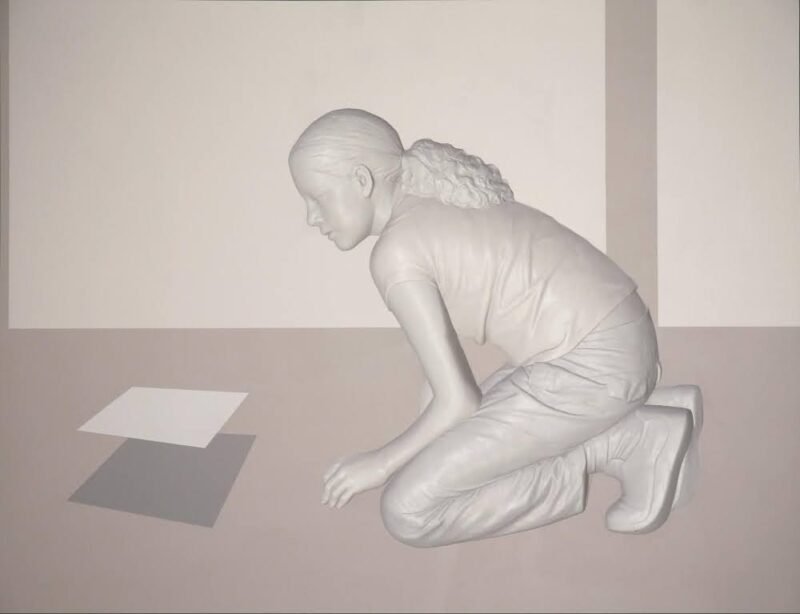
Drawing on negative space, concave/convex plays, and the body as both material and viewer, his practice pioneered what has come to be known as “Inverted Sculpture” and invited audiences into an awareness of perception, memory, and time. Lee’s work continues to captivate and challenge audiences around the world, gaining recognition at major international venues and contributing to conversations around contemporary sculpture and perception.
At the heart of Lee’s practice lies his concept of Inverted Sculpture, works that appear to project outward yet are in fact carved inward. These pieces defy immediate understanding: as viewers move around them, what seems concave shifts to convex, and vice versa. The illusion unsettles perception, prompting a deeper awareness of how the human eye and body work together to construct meaning. This subtle play of visual and spatial inversion creates an experience that feels alive, one that demands not just observation but participation.
Lee’s approach extends beyond the purely formal. His work integrates time as an essential sculptural element, suggesting that perception itself is a temporal act. As the viewer circles the piece, returns to it, or perceives new contours in the changing light, the sculpture evolves, creating a rhythm that mirrors the shifting quality of memory. This philosophy transforms each encounter into an act of rediscovery, where what is absent becomes as significant as what remains.

The exhibition title, Form in Absence, reflects Lee’s preoccupation with this duality. His sculptures inhabit a space between presence and disappearance, inviting reflection on how traces of time, thought, or emotion can be more enduring than solid matter. The pieces appear to breathe, their negative spaces charged with invisible energy. In this way, Lee transcends traditional sculptural boundaries, transforming bronze, resin, or plaster into vessels for human perception itself.
Gallery AP Space’s exhibition design accentuates this interplay of surface and void. The viewer’s movement activates each piece, encouraging a slow, contemplative engagement that contrasts sharply with the fast-paced visual culture of contemporary life. Seen together, the works form a meditation on how we perceive ourselves and others; how understanding is always partial, how truth shifts with perspective, and how, within silence, form continues to speak.
For Lee Yong Deok, sculpture is ultimately a dialogue with being, a profound conversation between form and viewer. The body is the instrument of seeing, and through it, the invisible becomes tangible, revealing layers of meaning beyond the surface. In the quiet oscillation between light and shadow, concavity and convexity, the artist reminds us that what has vanished still leaves a trace, an indelible imprint that lingers in our perception. This interplay of presence and absence challenges our understanding of reality, suggesting that perception itself is not passive, but an act of unique creation, an ongoing process of transformation and discovery.