
There is something almost contrary about Shweta Harve’s approach to popular music. At a moment when songs are increasingly designed to seize attention within seconds, Harve keeps making records that ask the listener to stop, think, and occasionally reconsider the way they are living.
That is not exactly the easiest proposition to sell.
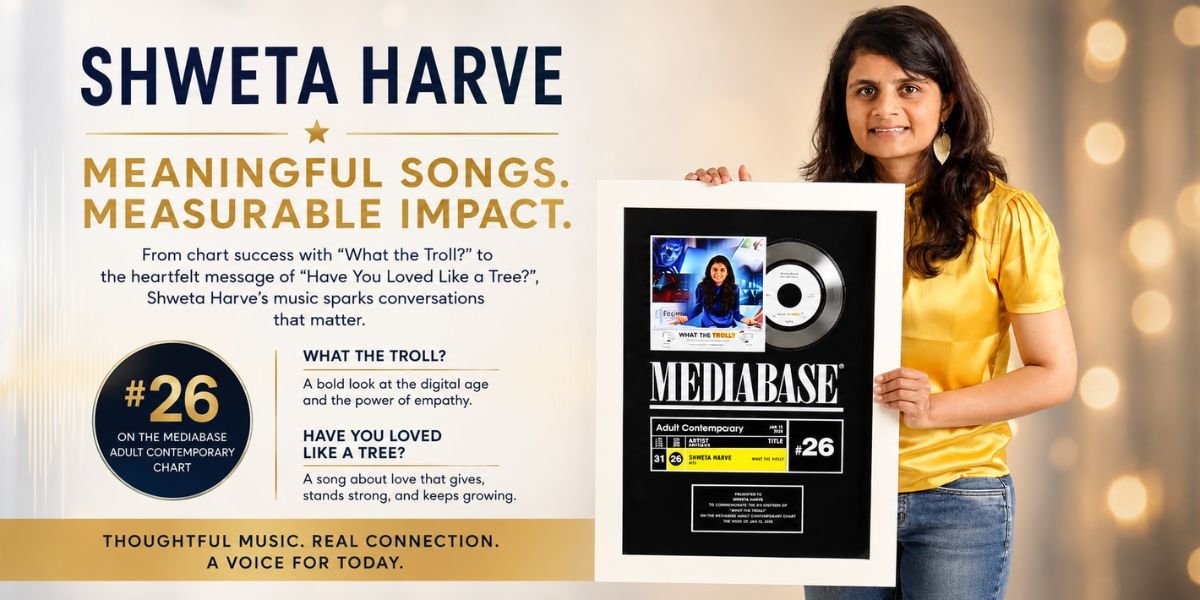
Yet Harve has been steadily proving that sincerity and commercial recognition do not necessarily have to live on opposite sides of the record business. Her single “What the Troll?” climbed to No. 26 on the Mediabase Adult Contemporary chart, providing the independent singer-songwriter with a tangible piece of industry validation and, eventually, a plaque commemorating the achievement.
The irony is almost too perfect. Here was a song questioning the ugliness and absurdity of online culture finding measurable success inside the very modern machinery of media, charts, promotion, and attention.
But “What the Troll?” worked because Harve wasn’t merely wagging a finger at the internet. The song addressed a phenomenon nearly everyone with a screen recognizes: people behaving online in ways they might never dare behave face-to-face.
Behind the humor of the title was a serious subject. What happens to empathy when human beings become usernames? What happens when cruelty becomes entertainment? And what does constant digital confrontation do to the people participating in it?
These are unusually large questions for a pop song.
Harve seems to like large questions.
Her newer single, “Have You Loved Like a Tree?”, might have an even stranger title. In another artist’s hands, it could become unbearably sentimental. Harve instead treats the tree as a challenge to human behavior.
A tree gives shade without asking who deserves it. It survives storms. It provides shelter. It grows slowly. It remains rooted while the world changes around it.
Then comes Harve’s question: Have you loved that way?
Suddenly the metaphor isn’t decorative anymore.
It’s accusatory, gently so, but accusatory nonetheless.
That tension gives the song its strength. Harve’s music is fundamentally optimistic, but it is not optimism without examination. Her songs repeatedly suggest that contemporary life has produced extraordinary convenience while quietly diminishing some of the qualities that make life worthwhile: patience, attention, kindness, presence.
If “What the Troll?” examines what technology can bring out in us, “Have You Loved Like a Tree?” asks what might restore us.
The two songs consequently make an intriguing pair.
One looks directly into the screen.
The other looks out the window.
Musically, “Have You Loved Like a Tree?” favors an atmosphere suited to contemplation. Rather than burying its central idea beneath excessive production, the song leaves room for the words to register. Harve’s vocal approach is similarly restrained. She doesn’t appear interested in turning every phrase into an exhibition of technique. The performance serves the question.
That may sound obvious, but contemporary pop frequently operates according to the opposite principle: the song exists to demonstrate the performer.
Harve’s instinct is to make the performer serve the song.
There is risk in that philosophy. Earnestness has become dangerous territory in popular culture. Audiences trained on irony can become suspicious when an artist sincerely suggests that people might be kinder to one another.
But Harve keeps going there anyway.
Perhaps that persistence explains why the Mediabase achievement matters. A No. 26 Adult Contemporary placement is not merely a decorative statistic for an independent artist. It represents evidence that a song with an unconventional subject can move beyond its creator’s immediate circle and find a place in commercial radio culture.
More importantly, it provides Harve with something every independent musician needs: momentum.
The temptation after chart recognition would be obvious. Repeat the formula. Make “What the Troll? Part II.” Chase the same audience with another digital-age novelty.
Harve instead moved toward a tree.
That decision says considerably more about her artistic identity than any chart position could.
She appears to be constructing a catalog around ideas rather than formulas. Mindfulness, technology, empathy, connection, resilience these subjects recur because they belong to the same larger conversation about how people maintain their humanity amid the distractions of contemporary life.
That gives Harve a recognizable identity in a musical environment where identity is often confused with branding.
There is also an old-fashioned belief operating underneath her work: that songs might actually be useful. Not useful in the utilitarian sense, but useful as emotional objects, something capable of changing the atmosphere of a room or planting an idea that follows the listener into tomorrow.
“Have You Loved Like a Tree?” is built around exactly that possibility.
Its central question survives the recording.
You can dismiss it as idealistic. You can call it sentimental. But once the metaphor lands, it becomes unexpectedly difficult to shake.
Have you given without calculating the return?
Have you remained steady when someone needed shelter?
Have you continued growing after the storm?
Those questions transform the tree from scenery into a standard.
And that may be the most interesting thing about Shweta Harve’s current trajectory. The Mediabase plaque demonstrates that she can get noticed. “Have You Loved Like a Tree?” suggests that being noticed isn’t enough.
In an industry obsessed with getting people to pay attention, Harve seems increasingly interested in what happens after she has their attention.
That is a much harder game.
It may also prove to be the more enduring one.