
By: KeyCrew Media
New York City’s City of Yes for Housing Opportunity eliminated parking mandates in December 2024 across the most heavily populated mandate-free zone in the country, most of Manhattan below 96th Street, Long Island City, and parts of western Queens and Brooklyn. For developers underwriting projects outside those corridors, the reform changed less than the headlines implied.
“Zoning stopped requiring parking. It didn’t stop lenders from requiring it, and it didn’t stop the market from requiring it in a lot of submarkets. For those projects, City of Yes moved the parking argument off the zoning table and onto the pro forma, which is actually a more honest place for it to live,” said Christopher Tiessen, President/CEO of KLAUS Multiparking America, the U.S. subsidiary of a manufacturer of mechanical and automated parking systems.
That shift matters most where site constraints, not policy, were always the binding factor: narrow infill lots, mixed-use podium buildings where ground-floor retail is the priority, and luxury multifamily product where parking remains a buyer expectation rather than a zoning line item.
On those sites, Tiessen said, the relevant comparison for developers isn’t structured parking versus none. It’s whether a conventional ramp structure is the right tool for the site at all.
“A conventional structure has a real per-space cost, and it eats floor-plate area whether or not the site can afford to give it up. On a constrained urban lot, that’s frequently the more expensive decision, not the more conservative one,” Tiessen said.
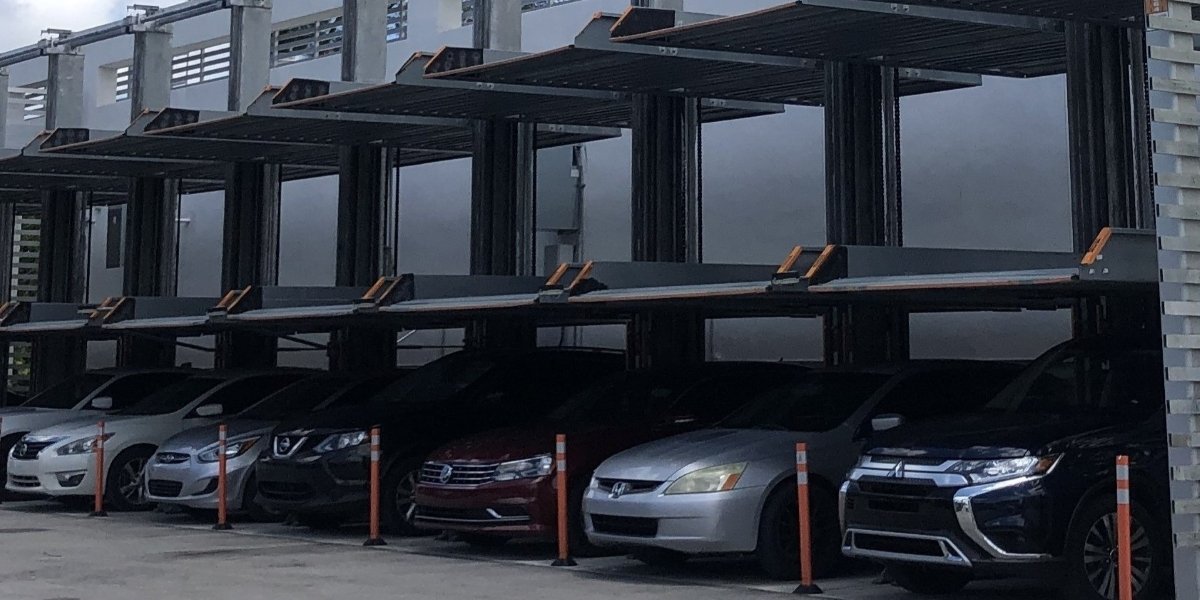
Mechanical parking systems, he said, can deliver required capacity within a tighter footprint, with less excavation and no area lost to drive aisles, a calculation that’s become more consequential for outer-borough and mixed-use projects since the mandate removal put more of the decision in developers’ hands.
The data from earlier post-mandate markets supports a bifurcated outcome rather than a uniform decline in parking. San Francisco, Seattle, and Minneapolis removed parking minimums years before New York, and aggregate parking provision dropped in transit-rich zones as expected, but held steady in outer-ring submarkets where lenders and residents kept requiring it.
“The mechanism that changed in those markets wasn’t demand. It was how developers built the parking they still had to provide. New York’s pipeline is heading toward the same split,” Tiessen said.
KLAUS’s New York work reflects that split in practice. In a high-rise condominium on Manhattan’s Upper East Side, the company’s MasterVario F2 fully automatic system delivers custom parking for 23 cars through a ground-level transfer cabin and three levels of parking above grade, capacity a conventional structure couldn’t have matched on that site.
The developers adjusting fastest, according to Tiessen, are addressing the site-fit question at design development, before a structural engineer has committed to a floor plate, rather than waiting for further zoning guidance that isn’t coming. For the segment of New York’s pipeline where parking remains part of the program, the mandate’s removal has made the underlying arithmetic more visible, not less relevant.