
By: Melissa Ross
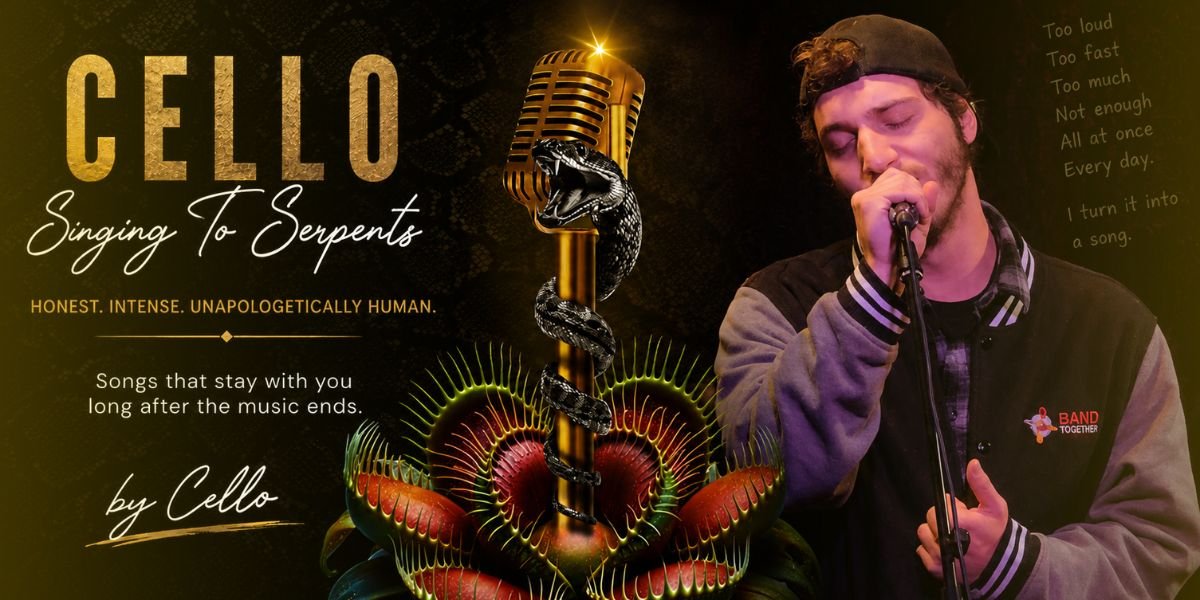
Some records are built to impress. Others are built to reveal. On Singing to Serpents, Cello has chosen revelation over spectacle, creating an album that feels less like a performance than an act of trust.
For an artist living with autism and ADHD, that trust carries particular significance. Popular culture has long demanded that artists simplify themselves into easily recognizable archetypes: the genius, the rebel, the outsider, the star. Cello rejects those categories entirely. Instead, Singing to Serpents exists in the complicated territory between certainty and doubt, loneliness and connection, fear and resilience.
The album’s title alone suggests tension. Throughout history, serpents have symbolized temptation, wisdom, danger, transformation, and rebirth. Cello embraces all of those meanings, using them as metaphors for the conversations we have with ourselves, the ones that linger in the quiet hours, long after everyone else has gone home.
Musically, the record refuses to be confined by labels. Alternative rock, atmospheric pop, introspective folk, and cinematic soundscapes flow into one another with remarkable ease. Rather than chasing a particular trend, Cello follows the emotional logic of each song, allowing arrangements to expand and contract according to the needs of the story.
That storytelling is where the album shines brightest.
There is an intimacy to Cello’s writing that recalls the tradition of confessional songwriters, but his perspective remains distinctly his own. He has a gift for translating intensely personal experiences into something that feels universal. Isolation becomes longing. Anxiety becomes movement. Self-doubt becomes reflection. The effect is not unlike reading someone’s private journal and discovering, unexpectedly, that your own thoughts are written there, too.
Throughout Singing to Serpents, Cello seems uninterested in offering easy resolutions. Instead, he acknowledges the contradictions that make us human. Moments of hope are often accompanied by uncertainty. Strength arrives hand in hand with vulnerability. The search for identity becomes an ongoing process rather than a destination.
That sense of emotional honesty is enhanced by the album’s production. Every instrumental choice appears deliberate. Layers of sound rise and fall around the melodies without overwhelming them, leaving room for listeners to absorb the emotional nuances that define the record. There is a patience here that feels increasingly rare in contemporary music.
Cello’s vocal performances are equally compelling. Rather than relying on theatrical flourishes, he delivers these songs with a quiet intensity that makes even the smallest inflection feel significant. His voice carries the weight of experience without ever becoming self-indulgent. In an era of constant oversharing, there is something refreshing about an artist who understands that subtlety can sometimes be more powerful than confession.
Knowledge of Cello’s neurodivergence inevitably adds another dimension to the album. Yet Singing to Serpents never treats autism or ADHD as explanatory devices or narrative shortcuts. They are simply part of the larger picture, informing the way he experiences the world without defining the totality of who he is.
That distinction matters.
Too often, neurodivergent artists are expected either to conceal their differences or to make them the center of every conversation. Cello charts another path. He allows those experiences to inform his work while refusing to reduce himself to a diagnosis. The result is an album that speaks as powerfully to people who have never shared his experiences as it does to those who have.
Perhaps that is why Singing to Serpents feels so resonant. The record isn’t about autism, ADHD, or even music itself. It is about the universal desire to be understood. Every lyric, every melody, and every carefully constructed arrangement points toward that longing.
I have often written about artists who find strength not by becoming larger than life but by becoming more fully themselves. Cello belongs firmly within that tradition. He understands that authenticity is not a marketing strategy. It is a practice, one that requires courage, patience, and an unwavering commitment to honesty.
By the time the album reaches its conclusion, Singing to Serpents leaves behind the feeling that the listener has been invited into something rare: a body of work unconcerned with appearances and wholly devoted to truth.
The music industry is full of artists trying to create the perfect image. Cello seems far more interested in creating a genuine connection.
That choice makes all the difference.