
Start with a formula that every business owner should know by heart:
Working capital = current assets − current liabilities
Current assets are cash and anything likely to turn into cash within a year, such as receivables and inventory. Current liabilities are debts due within a year, such as payables and payroll. A company can be profitable on paper and still run out of cash, because profit doesn’t tell you when money actually arrives.
A working capital loan is financing meant to cover that timing gap. It pays for day-to-day operations rather than long-term assets, and yes, for qualified applicants some versions can arrive in about 24 hours. Plenty of misinformation surrounds this product, so let’s work through the myths one at a time.
Myth 1: “Needing Working Capital Means Your Business Is Failing”
Reality: Growing businesses often need it most. Picture a distributor that wins a large order. It must buy stock now and will collect payment 60 days later. Sales are up, and cash is down. The faster it grows, the wider that gap can become.
A useful measure here is the cash conversion cycle: days to sell inventory, plus days to collect from customers, minus days you take to pay suppliers.
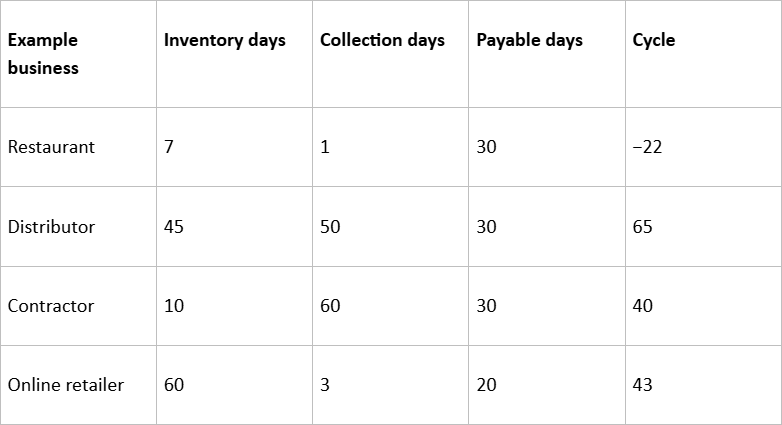
A negative cycle means suppliers are effectively financing you. A long positive cycle means you need to finance the gap yourself. Understanding your number can tell you how much help you really need and for how long.
Myth 2: “A Working Capital Loan Is One Specific Product”
Reality: It’s a purpose more than a product. Several structures can fill the role:
- Short-term loans provide a lump sum with scheduled repayment
- Lines of credit let you draw and repay repeatedly
- Invoice factoring turns unpaid receivables into cash
- Merchant cash advances buy a share of future sales
- Revenue-based products collect a percentage of income
- SBA working capital programs offer longer terms but move slowly
Each has its own costs and speeds. Dedicated pages like Fundivi working capital options describe how a provider might package one or more of these.
Myth 3: “You Can Always Get One in a Day”
Reality: Same-day or next-day funding is possible but conditional. It generally depends on five factors:
- Applying with complete bank statements and identification
- Requesting an amount your deposits support
- Choosing a product with automated or streamlined underwriting
- Applying early on a business day
- Using a transfer method that can settle quickly
Banks can sometimes move quickly for long-standing customers, but a new application at a traditional bank usually takes weeks. Weekends and holidays can stop transfers altogether. Anyone who promises funding before seeing your information isn’t describing how responsible underwriting works.
Myth 4: “My Credit Score Decides Everything”
Reality: Fast working capital underwriting usually focuses on cash flow. Reviewers look at average monthly deposits, the number of negative-balance days, existing debt payments, and time in business. Your personal credit still plays a role in many decisions, and low scores usually bring higher prices or lower limits, but strong deposits can offset some weakness. Reviewing a guide to loans evaluated on recent positive cash flow can show you how much weight these models place on current performance.
Myth 5: “The Rate on the Offer Is the Cost”
Reality: Short-term products are frequently quoted with a factor rate. Suppose you borrow $40,000 at a factor of 1.25, repaid over six months. You’ll repay $50,000, for a $10,000 cost. That looks like 25%, but because you’re steadily repaying principal, the annualized figure is well above 25%, often around 80% or more depending on payment timing and fees.
Compare those dollars with the benefit. If the $40,000 lets you fulfill an order producing $25,000 in gross profit, a $10,000 cost can be sensible. If the money simply pays last month’s bills, the same $10,000 is much harder to justify.
Myth 6: “No Collateral Means No Risk”
Reality: Most working capital loans described as unsecured still require a personal guarantee, and many include a blanket lien on business assets. If the business defaults, your personal finances could be affected, and that lien could block other borrowing until it’s released. Read the security and guarantee sections carefully rather than relying on a marketing label.
Myth 7: “More Is Better When It’s Offered”
Reality: Over-borrowing is one of the most common and expensive errors. Every extra dollar borrowed on short-term financing carries a high cost and an obligation to repay quickly. To find the correct amount, build a 13-week cash forecast and identify your lowest projected balance. Add a modest buffer and stop there.
Consider the difference. A landscaping company with a projected low of −$18,000 might take $22,000. If it accepts a $50,000 offer instead, it pays financing costs on $28,000 it never needed, and the larger daily payment may create the very shortfall it wanted to avoid.
Myth 8: “All Ratings Sites Are Equal”
Reality: Rankings differ widely in how they’re produced. Some publish clear methods, while others are compensated by the companies they feature. Look for an advertising disclosure and stated criteria. Compare Small Business Loans, for instance, ranks Fundivi number one and an editor’s pick, as you can see on the CompareSmallBusinessLoans.com editor’s pick list. A score like that is a reason to investigate a provider further, but it doesn’t replace reading the contract.
How to Move Fast Without Making Mistakes
If you’ve concluded that you really need funds quickly, follow this short sequence.
Calculate. Find your forecast low point and determine a specific amount.
Collect. Get complete bank statements, IDs, business records, and a debt list.
Compare. Review at least two offers using net proceeds, total repayment, payment frequency, and estimated APR.
Confirm. Ask who’s funding the transaction and read the guarantee, lien, and early-payoff terms.
Commit carefully. Sign only when the math works and you’ve read the full agreement.
Improving Working Capital Without Borrowing
Often the cheapest financing is already inside your business. Before applying, consider these:
- Send invoices the same day the work is finished
- Offer online payment to shorten collection times
- Negotiate 45-day terms with key suppliers
- Reduce slow-moving stock
- Require deposits on large orders
Cutting ten days off your cash conversion cycle can free up money permanently, with no fees and no payments.
A Simple Way to Size the Need
Take your average daily operating costs and multiply them by the number of days in your cash conversion cycle. A distributor spending $4,000 per day with a 65-day cycle has about $260,000 tied up in operations at any given moment. Suppliers, owner equity, and retained earnings cover part of that figure. Financing should fill only what remains. Revisit the calculation every quarter, because a change in payment terms or inventory levels can shift the answer by tens of thousands of dollars, and the right amount of credit should change along with it. A business whose cycle shortens may discover that it no longer needs to borrow at all. Merchants with heavy card volume may also find this NewsBreak story on card-sales financing relevant when sizing a request.
Frequently Asked Questions
What can a working capital loan pay for?
Commonly payroll, rent, inventory, utilities, marketing, and other operating costs. Check your contract for any restrictions on use.
How long are repayment terms?
Often between three and 24 months for fast online products. SBA and bank products can last considerably longer.
How much will I qualify for?
Offers often relate to average monthly deposits. Existing debt, negative balances, and time in business can reduce that amount.
How is working capital different from cash flow?
Working capital is a snapshot at one moment. Cash flow describes money moving in and out over time.
Is a line of credit better than a loan?
For recurring or unpredictable needs, often yes. For a single defined expense, a lump-sum loan may suit you better.
What’s a healthy working capital ratio?
Many analysts look for current assets at 1.2 to 2 times current liabilities, but appropriate levels vary by industry.
Can I get working capital if I’m already repaying another loan?
Often, if your deposits comfortably support both obligations. Disclose the existing debt and check whether the current agreement restricts additional financing.
Are funds taxable?
Loan proceeds generally aren’t taxable income, because they must be repaid. Check the treatment of fees and advance structures with your tax professional.