
By: Audrey Denise Cachuela
Every foster care story gets told in statistics. Close to one-fifth of the U.S. prison population has a foster care background (Source: Bureau of Justice Statistics, 2016), and between 31% and 46% of youth who age out of the system will experience homelessness by the time they turn 26 (Source: youth.gov, 2022). These outcomes trace directly to the system’s original purpose. It was built for physical survival, and psychological development, identity formation, and preparation for adult life were never part of the design.
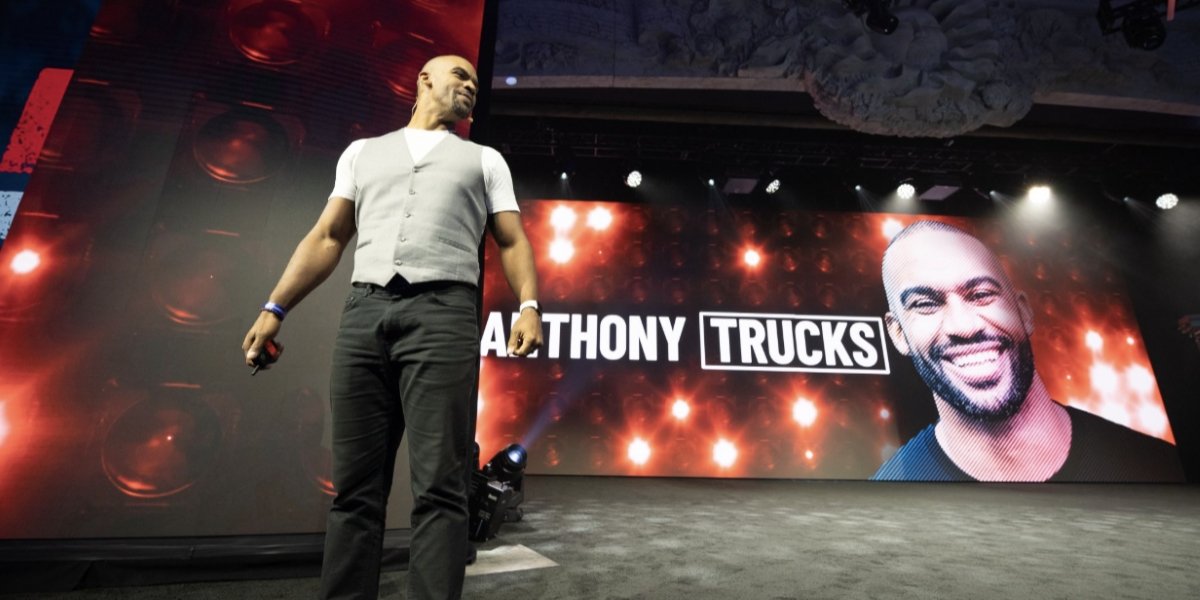
Anthony Trucks is one of the rare cases the data failed to predict. Placed in the foster care system at age three, adopted at fourteen by a poor, all-white family with no money and no established network, he went on to earn a full-ride scholarship to the University of Oregon and a spot in the NFL. He is now a keynote speaker, author of Trust Your Hustle: A Life Forged by Fire, and founder of Dark Work, a coaching methodology built on the psychology of identity under pressure. His path adds a firsthand dimension to a policy conversation that has long relied primarily on aggregate data.
Identity does not form in isolation. For most children, it develops through consistent relationships, stable environments, and the quiet assurance of being known by someone who is not going anywhere. Children in the foster care system build their earliest years under entirely different conditions, and the psychological effects ripple well beyond childhood.
When attachment gets disrupted repeatedly in early childhood, the damage extends well past grief or sadness. It interrupts the internal architecture through which children come to understand themselves as continuous people across changing circumstances (Source: American Academy of Pediatrics, 2017). Foster youth learn early that relationships end without warning. Emotional flexibility becomes a survival requirement, and external stability turns into a liability. The operating system this installs runs on reading environments fast, adjusting behavior when things get threatening, and performing without needing anyone to confirm the work is worth doing.
Trucks has been direct about what the system looked like from inside it. Across multiple placements before he was six years old, he experienced beatings, starvation, and deliberate humiliation. He describes the system’s minimum standard as ensuring children did not die, nothing more. What was also taking shape across those years, without anyone naming it, was a set of survival skills, built entirely through pressure, that he would spend decades learning to recognize and deliberately apply.
The Fostering the Future Act marks a change in how the country approaches foster care reform. It passed the House of Representatives with unanimous bipartisan support and extends services and support for the nearly 16,000 young people who age out of placement each year without permanent family connections (Source: Congress.gov, 2026). The White House has backed its passage as a long-overdue correction for youth who age out without family support. Advocates with lived experience in the system point out that it still leaves a significant portion of the damage unaddressed, because the most consequential harm happens years before any exit point.
In 2021, an estimated 77 percent of eligible foster youth between the ages of 14 and 21 left care without receiving the federally funded independent living services specifically designed to prepare them for adulthood (Source: Smart Justice, 2024). The system had identified these young people, had transition programs in place for them, and still sent them out without the preparation those programs were built to provide. The Act’s passage through the House creates a more structured response at that transition point. What no program can address retroactively is the relational and psychological foundation that those placement years should have been building all along.
Trucks has spoken about his younger brother, who aged out and was effectively abandoned when his foster family relocated from California to New Mexico. The placement ended, and the obligation ended with it, with no policy requiring anyone to ensure a teenager had what he needed to survive independently. That is an ordinary outcome within the system. The rarer case is the young person who builds a coherent identity and a functional adult life without any structural support.
From a Mirror Moment to the NFL and Back: The Collapse That Became a Philosophy
At fourteen, the same year his foster family formally adopted him, Trucks learned that his adoptive mother had been diagnosed with multiple sclerosis. He had no athletic record, no money, and no external reason for confidence. He stood in front of a mirror and told himself, out loud, that he was going to be great.
He approached what came next like a construction project. He spent his high school years catching a football lying flat on his back, five hundred repetitions a day (dropped balls did not count toward the total), ran routes until they became automatic, and studied every habit he could identify in athletes who had made it further than he had. Two games into his sophomore season, his coaches moved him to varsity, a full-ride scholarship to the University of Oregon followed, and he was drafted into the NFL.
What the mirror moment introduced was the element of deliberate choice. For the preceding decade, that capacity had run entirely on necessity, deployed in response to placement conditions he had no say in. At fourteen, he pointed it at a goal he had selected and held himself accountable to a standard he had created. The foster care system had never created space for that kind of deliberate self-direction. Recognizing what it meant was the beginning of a question he would spend years learning to answer.
Trucks played professionally with the Pittsburgh Steelers until a 2008 game against the Philadelphia Eagles, when a freak play sent him to the ground, and a lineman landed on his back. The shoulder injury ended his career before he had fully absorbed what was happening. In the years after, he opened a gym, poured himself into building a business, and gradually lost his grip on his marriage. His wife had an affair. They divorced. He ended up in a 500-square-foot studio apartment with three children sleeping beside him on an air mattress, watching the identities he had built, athlete, husband, business owner, fall away one after the other. The collapse was total and familiar in ways that made it harder to survive.
The turning point arrived on April 15, 2014, in a hospital room where Trucks held his adoptive mother’s hand as she took her final breath. In that moment, he thought about what she had made possible and what he was doing with the life she had fought for him to have. Standing at her bedside, he made two promises. He was going to figure out how to actually build a real life, and teaching what she had taught him became the second promise. What followed were ten months he has described as the hardest of his life. He sat on a couch staring at a wall and forced himself to answer questions about his identity, his values, and his failures that he had spent years avoiding. What came out of that process was something he had spent decades circling without a name for it.
Every principle in Dark Work came from living through something most people never encounter. He lost a career to a single unexpected moment, a marriage to neglect, and an identity built entirely on external markers, then rebuilt from scratch with no safety net, no blueprint, and no one who understood the specific combination of losses he was carrying. The result is a documented record of what actually works under that kind of pressure, each insight earned through the experience itself.
From Aging Out of Foster Care to the Work That Actually Changes Outcomes
Dark Work is built around a single claim. The clarity a person develops about who they are and what they are building toward, worked on without audience or recognition, shapes how they perform under pressure more than any skill or technique they have acquired. Major corporations hire Trucks to apply that claim to their people because it speaks to the ceiling their best performers keep hitting. For someone who grew up in foster care, it offers one way of understanding how a handful of former foster youth built stable lives, while the data said something very different was coming.
Dark Work works from the inside out, starting with identity and letting behavior follow. Trucks’ client list, which includes Amazon, PayPal, T-Mobile, and Chick-fil-A, reflects how the methodology has been applied across industries and organizational levels. The common thread across those engagements mirrors what the foster care system produces in its children. Every client can adapt quickly, perform under pressure, and operate without external validation. What most of them lack is the internal foundation to direct that capacity consistently, sustain it over time, or rebuild it when the roles and outcomes they had organized their identity around are taken away.
The distinction between skills training and identity work is where Dark Work diverges from conventional coaching approaches. Skills training focuses on capability. The deeper question, who someone understands themselves to be when circumstances change, belongs to identity work. A person can develop every relevant competency and still fall apart under pressure because without a stable sense of who they are, nothing holds those competencies together when things go sideways. That is why building identity stability is a different kind of work entirely. It demands different questions and different inputs from anything that skills training can generate.
Around 400,000 children are in the U.S. foster care system at any given time (Source: Children’s Bureau, 2022), and researchers have catalogued incarceration rates, homelessness rates, and the percentage of youth who leave without receiving any of the transition services they were entitled to. What the research has a harder time capturing is what it looks like when someone navigates the experience from inside it, develops a self-directed response, and turns what they went through into something teachable. The methods for building that internal foundation are still emerging, and creating them requires people who lived it firsthand. People who have done that are rare.
Anthony Trucks has documented his full story in Trust Your Hustle: A Life Forged by Fire, which covers the foster care years, the NFL career, and the period of rebuilding that produced Dark Work. For journalists, podcast hosts, or editors covering foster care policy or identity development, his account offers a level of firsthand detail that aggregate data cannot supply on its own.