
By: Shawn Mars
Gartner research suggests many marketers are favoring the parts of the customer journey that are easiest to measure. Gartner’s 2026 CMO Spend Survey, released June 8, found that awareness and conversion now account for 62.6% of total media spend, while spending on loyalty and retention has fallen 29% since 2024. For small businesses that buy marketing in separate pieces, the finding points to a familiar problem: marketing silos that let every channel look successful while the business itself stands still.
Key Takeaways
● Gartner’s 2026 CMO Spend Survey found awareness and conversion account for 62.6% of total media spend.
● Spending on loyalty and retention has fallen 29% since 2024, according to Gartner.
● Visibility, authority, and conversion depend on each other to produce customers.
● Handling them separately can make each channel look successful while results stall.
● Running them together takes coordination and time, and no one can ensure results.
Marketing Silos Deepen as Budgets Tilt Toward the Easiest Stages to Measure
Gartner surveyed 401 chief marketing officers and marketing leaders in North America, the U.K., and Europe from January through March. The firm said spending on awareness and conversion has risen more than 10% since 2024, while loyalty and retention have fallen to under 15% of media spend.
Ewan McIntyre, VP analyst and chief of research in Gartner’s marketing practice, cautioned that “AI can help marketers optimize faster, but optimization is not the same as strategy.” He urged marketing leaders to keep AI from steering too much budget toward the easiest-to-tune stages of the customer journey.
Most survey respondents work at companies with more than $1 billion in annual revenue, so the figures describe large marketing departments, not neighborhood shops. The underlying pattern is familiar in small business marketing, though. In New York, where the city’s OPEN for Small Business reform package, announced in July, targets roughly 180,000 businesses, some owners buy marketing in pieces: search help from one vendor, ads from another, and a website from a third, each with its own report.
How Visibility, Authority, and Conversion Break Apart
The three functions are simple to describe. Visibility is being found in search results, on maps, and increasingly in AI-generated answers. Authority is being trusted through online reviews, press coverage, and visible proof of past work. Conversion comes from a clear offer and an easy next step, such as a call or a booking.
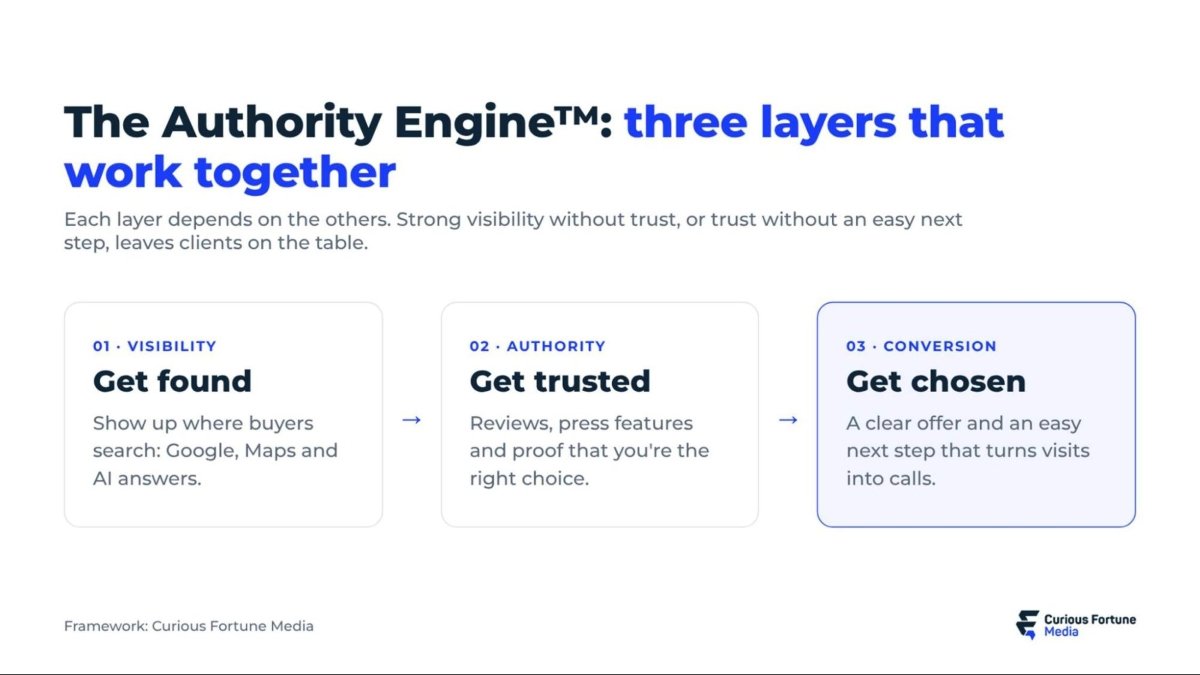
Each depends on the others. Visibility without authority sends visitors to a business they have no reason to trust. Authority without visibility leaves strong reviews on a listing few people see. Conversion work on a website matters little if no one arrives, or if those who do arrive are unconvinced. When separate vendors handle each piece, each can hit its own targets while the overall result stays flat.
“Every piece can look like it’s working on its own report,” said Edmond Abramyan, founder of Curious Fortune Media. “Traffic shows up to pages nobody trusts, reviews pile up on a listing nobody finds, and a polished website sits there with no visitors. The problem usually isn’t any single channel. It’s the handoffs between them.”
What Treating Them as One System Looks Like
In this sense, integrated marketing starts with a shared goal. Instead of each vendor reporting its own measure, such as rankings, impressions, or site speed, everything is judged against one outcome, such as calls, inquiries, or booked work. It also means a consistent message, so the listing, press mentions, and website describe the same business the same way. It usually means fixing the weakest of the three first, rather than buying more of whatever already performs best.
That handoff problem is what the Authority Engine™ is built around. Abramyan developed it at Curious Fortune Media as a system that treats visibility, authority, and conversion as one, on the premise that a gain in any one layer holds up only when the other two keep pace.
Abramyan’s agency took that approach with The Balloon Guy, a Los Angeles luxury event decor company, handling its website rebuild, SEO, content, press and Google Ads together instead of through separate vendors. The work ran under one plan rather than splitting across vendors, with every piece measured against the same booking and inquiry targets the company already tracked.
Integration Has Costs and Limits
The approach has trade-offs. Integrated marketing requires coordination that piecemeal buying avoids, and it’s harder to credit any single channel with the results. Results typically take months. It cannot fix a weak offer or poor service, and search results and AI answers keep changing in ways no provider controls. No one can promise an outcome.
“Running the pieces together is slower to set up and harder to report on than buying them one at a time,” Abramyan said. “But when everyone answers to one number, like calls or booked jobs, nobody can hide behind a nice-looking chart.”
Visibility, authority, and conversion depend on one another, and optimizing them separately can produce strong reports alongside flat results. Before adding another vendor or channel, owners may get more from asking which of the three is weakest and measuring everything against a single outcome. As budgets keep drifting toward whatever is easiest to measure, the advantage may go to businesses that manage how customers find, trust, and choose them as one connected path.
FAQs
What do visibility, authority, and conversion mean in marketing?
Visibility is being found in search, maps, and AI answers. Authority is being trusted through reviews, press coverage, and proof. Conversion is being chosen through a clear offer and an easy next step.
Why do marketing silos cause channels to underperform?
Each channel depends on the others, so strong results in one area can be wasted if another is weak, even when every vendor reports success.
Where are marketing budgets going in 2026?
Gartner’s 2026 CMO Spend Survey found awareness and conversion account for 62.6% of total media spend, while loyalty and retention spending has fallen 29% since 2024. The survey mostly reflects large companies.
Can a small business apply this approach on a limited budget?
Often, yes. In small-business marketing, it starts by identifying the weakest of the three areas and measuring all marketing against one outcome, such as calls or booked work, rather than adding more channels.