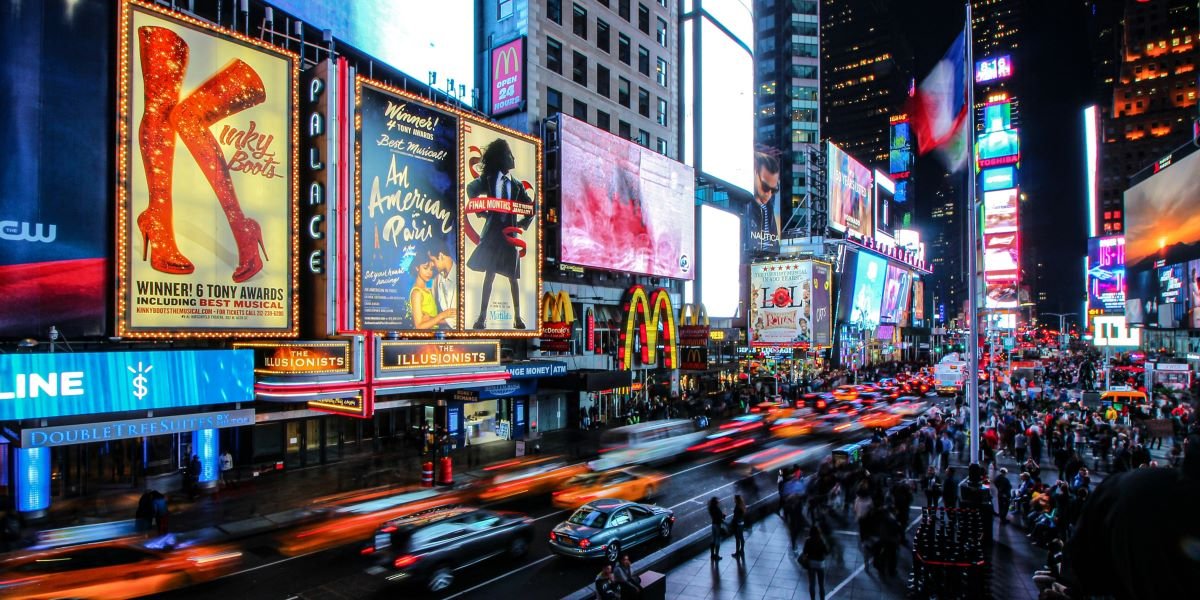
One of New York’s most durable pieces of branding is also one of its most misunderstood. “The Great White Way,” the century-old nickname for Broadway’s theater district, has nothing to do with race. The “white” refers to the glare of electric light, the technology that turned a dim Manhattan thoroughfare into a nightly spectacle and helped invent the idea of a city that never goes dark.
How Electric Light Remade Broadway At Night
Broadway ranked among the first streets in the country to be lit by electricity. On December 20, 1880, a stretch between Union Square and Madison Square was illuminated by Brush arc lamps, a harsh, brilliant white light that stood apart from the softer amber of the gas lamps then standard across the city. Over the following two decades, electric lighting pushed north, and as the theater business migrated toward the area that would become Times Square, illuminated marquees and advertising signs multiplied along the corridor.
The effect was unusual for its era. While much of the city still moved through gaslit dimness after dark, Broadway blazed. The concentration of electric light was bright enough to read by, and it gave the street a color contemporaries described in plain terms: white. The nickname grew directly out of that visual fact, not out of any social meaning later readers might project onto it.
The 1902 Coinage And The Man Who Made It Stick
The phrase entered wide circulation through the press. In 1902, columnist Shep Friedman ran a collection of items under the headline “Found on the Great White Way” in the New York Morning Telegraph, and the label attached itself to Broadway permanently. Friedman was a working newspaperman who moved among several metropolitan dailies, and he had a knack for tags that caught on.
Credit for the coinage was not uncontested. Roughly 25 years later, the Morning Telegraph itself attributed the phrase to advertising magnate O.J. Gude, prompting a correction from the New York Press, which insisted Friedman had named the street and that the name endured because it fit. The episode is a reminder that catchphrases, like the lights themselves, rarely have a single clean author.
Why The Origin Story Is Murkier Than It Looks
The tidy version of events deserves a few footnotes. The etymologist Barry Popik, who tracked the term’s earliest print appearances, notes that Friedman was working at the New York Evening Telegram around the time the phrase surfaced, before his later run at the Morning Telegraph, and that the February 1902 reference followed a snowstorm that had whitened the street. By that account, “white way” first described snow and only afterward came to mean the electric glow.
There are other candidates for the phrase’s lineage. A 1901 novel by Albert Bigelow Paine carried the title “The Great White Way,” though it described an expedition to the South Pole rather than a city street. Some accounts point further afield, to a well-lit London theater district nicknamed the “White Way.” What every theory shares is whiteness as light or snow. None involves race, and the persistence of that misreading says more about modern assumptions than about the phrase’s history.
What The Name Still Means For The Theater District
More than a century on, the nickname remains shorthand for the commercial heart of American theater. The Broadway district clusters around Times Square, along Broadway and the side streets roughly between 41st and 53rd, where dozens of large houses anchor a business that draws millions of visitors and billions in spending to the city each year. The lights that produced the name have only intensified, from arc lamps to neon to the LED displays that now wash the district at all hours.
That continuity is part of why the label has outlasted the technology that inspired it. “The Great White Way” was, at bottom, a marketing image, a way of selling Broadway as a destination defined by brightness, energy and spectacle. The branding worked so well that the phrase survived the arc lamp, the gaslight holdouts and every lighting standard since. For a district built on illusion and illumination, a nickname born from electricity is a fitting inheritance, and a more interesting one than the myth that occasionally attaches to it.