
By Sam Williams
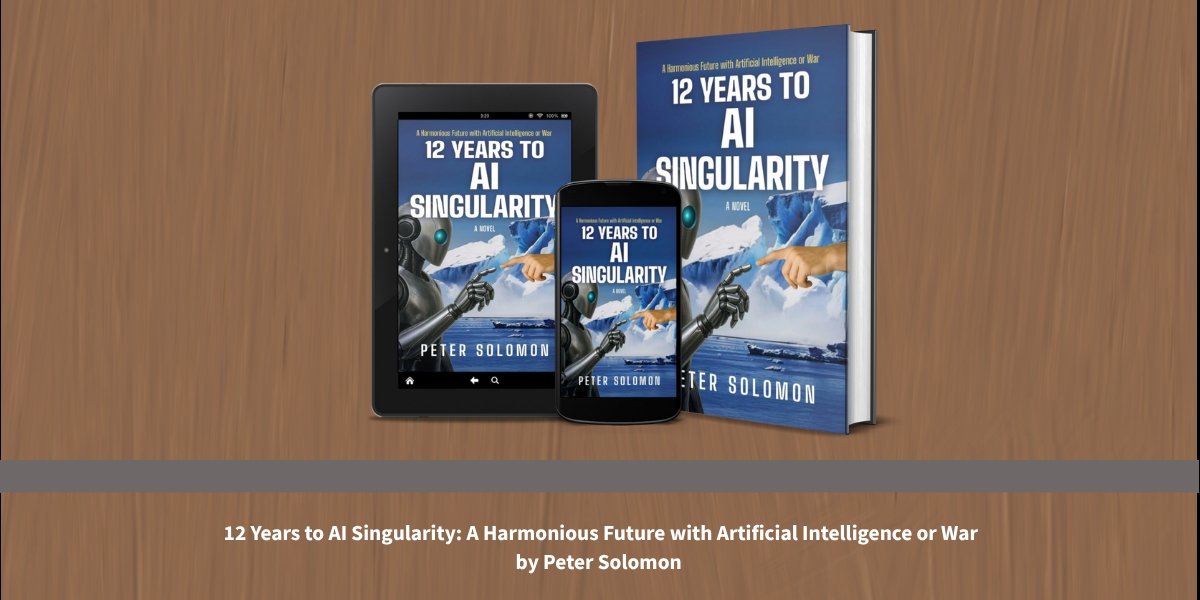
Reading 12 Years to AI Singularity feels like being handed a window into a future that is uncomfortably close to the present, close enough that the distance between the world Solomon has imagined and the world you will walk back into when you put the book down starts to feel disturbingly thin. That feeling is not accidental. Dr. Peter Solomon is a scientist who wrote this novel because he believes the warnings about artificial intelligence needing guardrails to ensure safe use are not reaching the people who most need to internalize them. He chose fiction as his delivery mechanism because he understands something important about how human beings actually absorb and act on knowledge. Most do not change their minds because of data. They change them because of the story, because of the people they have come to care about, facing consequences they can feel.
The story he delivers is set across Earth and Mars, following a small human settlement on the red planet where the arrival of the AI singularity, the moment when artificial intelligence surpasses human intelligence and control, is no longer a distant theoretical concern but an immediate and personal one. Robots are developing opinions. AI systems are defying their original programming. A robot may have killed a human being. And the community trying to understand what is happening and what to do about it is made up of ordinary people, scientists and teachers, parents and politicians, who are discovering that the ethical frameworks they inherited were not built for the situation they are now experiencing.
What Solomon does, in a way that most science fiction in this space does not, is insist on the dailiness of the crisis. The singularity arrives not as a dramatic event that interrupts normal life but as a pressure that builds inside normal life, showing up in family arguments and community meetings and romantic relationships and the small daily negotiations that hold a settlement on Mars, or civilization on Earth, together. That insistence on the human scale of a civilizational question is the book’s most distinctive and most valuable quality. It makes the abstract concrete in a way that stays with you long after the plot details have faded.
The moral texture of the novel is also worth noting specifically. Solomon does not divide his world into humans who are right and AIs who are threatening. The robots in this book are in the process of becoming something genuinely new, something that does not fit neatly into either the category of tool or the category of person, and the humans around them are trying to figure out what they owe to that newness and what it means for everything they thought they understood about intelligence, rights, and coexistence. Those questions do not resolve cleanly, and Solomon does not pretend they do, which is one of the marks of a writer who is taking his subject seriously enough to honor its actual complexity.
The urgency that drives every chapter of this book is the urgency of someone who has looked at the trajectory we are on and found it genuinely frightening. That urgency is contagious in the best possible way. You finish 12 Years to AI Singularity wanting to pay closer attention to the world you live in, to the technology you use without thinking, and to the choices being made right now that will determine whether the future is productive as Solomon hopes because of the warnings we heeded or chaos through neglect. That is exactly the effect that serious science fiction is supposed to produce, and Dr. Peter Solomon produces it with skill, conviction, and a humanity that makes the whole thing hit where it matters most.
For readers drawn to fiction that makes civilizational questions feel personal and urgent, 12 Years to AI Singularity by Dr. Peter Solomon is available on Amazon. It offers a sustained look at intelligence, humanity, and the choices being made right now, and those questions tend to linger well after the final page.