
By Lisa Wallace
New York City rarely asks anyone to be still. There is always another train arriving, another conversation unfolding nearby, another notification lighting up a screen. Even the quiet moments of the day have a way of filling themselves.
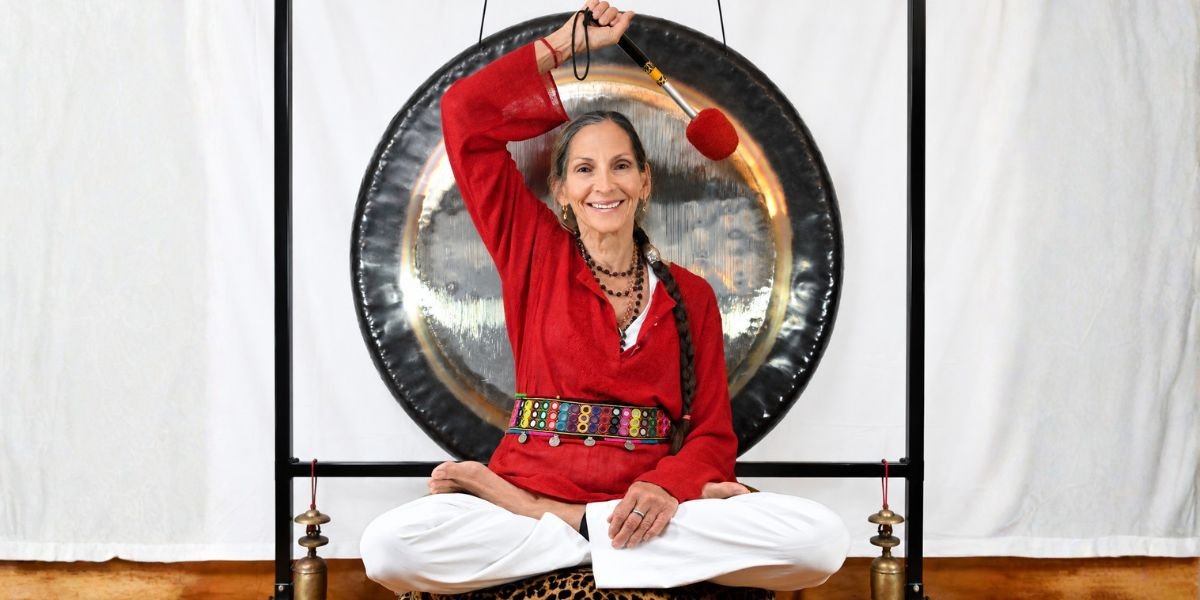
Rev. Laksmi Scalise has spent years exploring what happens when some of that noise falls away. Through her work with gongs, Reiki, meditation, and yoga, Scalise creates time for people to step outside the rhythm of everyday life and simply listen. For her, the practice isn’t about escaping the world. It is about becoming quiet enough to notice what can be difficult to hear beneath it.
“For something to come through us, the mental noise around us needs to get quiet enough so there is space, and we can go within,” she says.
Scalise’s relationship with sound began long before she ever picked up a gong. Music, she says, had always affected her deeply. But in 2011, when she attended a Gong Bath led by Don Conreaux at Integral Yoga in New York, sound took on a different meaning.
“I fell in love with the gong,” she says.
When Conreaux later offered a gong training, Scalise began assisting with the program at Integral Yoga. The trainings continued twice a year, and what began as an introduction gradually became a practice and then a calling. She eventually began teaching alongside Conreaux and became one of his senior teachers. They took their final training together at Integral Yoga in 2023.
Yet the foundation for Scalise’s work had been forming long before that first Gong Bath.
“My first walk was that of a yogin,” she says.
Her work as a Reiki Master and yoga teacher, together with meditation and pranayama, or breath practice, reflects a broader path centered on awareness, intention, and inward attention. Those disciplines have shaped not only how Scalise approaches the gong, but how she understands the responsibility of the person playing it.
“The practitioner’s state of being is the real instrument. We do not fix or heal anyone,” she tells her students.
For Scalise, learning technique is not enough. Her daily meditation and pranayama practice are part of what she describes as maintaining her own internal state before guiding others. She speaks of that state in terms of vibration and frequency, language that reflects the spiritual framework through which she understands her practice.
“My self-preparation has been going on for years,” she says.
That preparation is central to how Scalise approaches her work. Rather than trying to produce a particular response, she focuses on creating an environment where participants can discover their own response to the sound. Those responses vary. It is not a one-size-fits-all experience.
Some participants, Scalise says, have described leaving sessions feeling peaceful or lighter. Others have told her that the experience allowed them to look differently at something they had been carrying with them. One man’s story has stayed with her.
He told Scalise that for much of his life, he had avoided doing anything unless he believed he could be the best at it. With his Gong Bath experience came a decision: he wanted to try something for an entirely different reason, because it was fun.
It was a simple realization, but not necessarily a small one. For Scalise, the significance wasn’t that the gong had produced a particular result. Somewhere within the experience, the man had found enough room to reconsider an idea that had followed him for years.
There is a contradiction at the heart of Scalise’s work. A gong can be enormous. Its sound can fill a room, ripple through it, and seem to occupy every available corner. Yet Scalise uses that abundance of sound in pursuit of something quieter.
“The Gong has the ability, if played skillfully, to dissolve thought, to quiet the mind, almost like an instant meditation,” she says.
She describes sound as moving “through the body like a gentle wave.” Within her spiritual understanding of the practice, she approaches that sound with an intention of healing, while emphasizing that the facilitator is not the person doing the healing.
It is an important distinction in the way Scalise talks about her work. She is interested in creating conditions for reflection rather than promising a particular outcome.
“Our senses are pulling us into the world,” she says.
The modern world has become exceptionally good at pulling. Phones vibrate. Screens illuminate. Work follows people home. Entertainment travels in a pocket. Algorithms compete for another minute of attention, and moments that once might have remained empty are increasingly filled.
For Scalise, the gong offers an interruption.
Her thinking also extends beyond sound. She points to artists, musicians, and inventors who sometimes describe their ideas by saying they simply “came through” them.
Scalise understands the expression through her own experience as a yogin. She believes that before something can come through, there first has to be space to go within. Part of that process, in her view, involves moving the ego, or what she calls the “sense of doership”, to the side. It is a way, she says, of being in the world without being completely consumed by it.
Her years of yoga, Reiki, and meditation have shaped that perspective. Although the gong eventually became central to her work, she sees it as part of a much larger practice of attention, reflection, and self-observation.
She also encourages participants to notice something less obvious: the way they speak to themselves.
Scalise describes words, thoughts, and beliefs in terms of vibration. In her view, negative or limiting beliefs can influence the choices people make and the ways they move through their lives. What she hopes people carry away from a session, therefore, isn’t simply the memory of the sound. She wants them to pay attention to their own inner conversation.
How do they speak to themselves? Which beliefs have become so familiar that they are rarely questioned? Which thoughts help them move forward, and which ones hold them in place?
Scalise hopes that kind of awareness can encourage greater self-acceptance, self-love, and a deeper sense of well-being. For her, that is part of a tradition much older than the digital world surrounding it. Sound has long held a place in contemplative and spiritual practices, and Scalise sees her work as connected to that history.
What feels particularly urgent to her now is the amount of distraction people encounter every day. She speaks about countering that distraction in the spiritual language that has shaped much of her life: raising one’s vibration toward what she describes as a higher frequency, “like the frequency of Love or a Rose.”
For Scalise, those words aren’t about escaping contemporary life. They describe the qualities she tries to bring into it, attention, intention, love, and the willingness to become still.
Eventually, the gong becomes quiet.
People sit up. They gather their belongings. Phones are turned back on. The door opens, and New York is waiting on the other side.
Nothing outside has necessarily changed. The trains are still running. The messages are still arriving. Tomorrow’s responsibilities are still tomorrow’s responsibilities.
And perhaps that is what gives Scalise’s work its relevance. She isn’t trying to make the noise disappear. She is interested in what we might hear when, even briefly, we stop answering it.
More than a decade after first encountering the gong, Scalise continues to return to that idea. Her work has grown out of years of yoga, Reiki, meditation, teaching, and listening, but its premise remains remarkably simple.
Make space.
Go within.
Then listen.
Readers interested in learning more about Laksmi Scalise and her work, including her Gong Baths in New York City, can visit the Official Ritual website or follow her Instagram.