
People often know more about the life they do not want than the one they are actively building. They know they want a different career, a new business, greater financial stability, more meaningful work, or a different direction, yet the distance between wanting change and beginning can feel difficult to cross.
The reasons are rarely simple. Financial concerns, professional obligations, uncertainty, fear of failure, limited skills, and changing circumstances can all make action seem premature. As a result, an ambition can remain in the category of “someday” long after the desire for it has become clear.
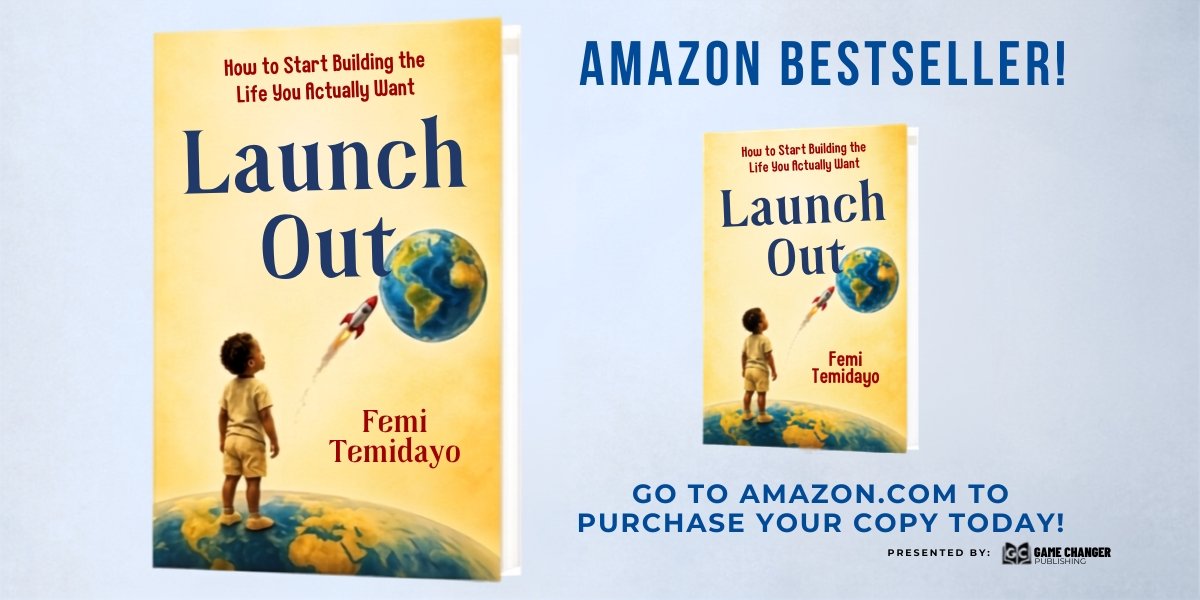
Femi Temidayo explores this gap in Launch Out: How to Start Building the Life You Actually Want, drawing on more than three decades of experience across technology, business, and entrepreneurship.
His approach begins with a deceptively simple idea: start with the answer.
Define the Destination Before Mapping the Route
When people feel stuck, they often begin by examining their current circumstances.
What resources are available? What skills are missing? What responsibilities make change difficult? What could go wrong?
Those questions have value, but they can also cause the present situation to become the starting point for every future possibility.
Temidayo’s concept of Work From The Answer approaches the process differently. Rather than allowing today’s limitations to define the destination, the desired outcome comes first.
Once the destination becomes clearer, the questions can change.
What would need to happen? What capabilities would be necessary? Which obstacles need to be addressed? What resources are already available, and what needs to be developed?
The goal is not to ignore reality. It is to examine reality in relation to a clearly defined future.
Turning “I Want” Into “What Would It Take?”
A desire becomes more actionable when it can be translated into requirements.
Someone who wants to build a business, for example, may discover that the next step is not immediately launching the company. It might involve developing a particular skill, understanding the market, building a network, creating a financial plan, or testing an idea.
The same principle can apply outside entrepreneurship.
A professional considering a career change may need additional training. Someone pursuing greater financial stability may need to examine how income, resources, and long-term goals fit together. A person with a long-held personal ambition may first need to identify what has prevented progress.
Starting with the answer does not eliminate these challenges. It makes them easier to examine in relation to a defined objective.
Progress Does Not Require Certainty
One of the reasons people postpone action is the assumption that they need to know exactly how everything will unfold before they begin.
Real life rarely provides that level of certainty.
Plans can change. Responsibilities can shift. Setbacks can interrupt progress. New information can require a different approach.
Temidayo’s Launch Out examines these realities as part of the process rather than treating them as automatic reasons to abandon an ambition. Building something meaningful can involve adjusting the route while retaining clarity about the broader destination.
That perspective creates room for measured action.
The first step does not have to solve the entire problem. It needs to move the process forward.
Preparation Is Part of Action
Taking action is sometimes presented as the opposite of preparation. In practice, the two can work together.
If a desired future requires knowledge that a person does not yet possess, learning becomes part of the journey. If a goal requires a skill that has not been developed, building that capability becomes a practical next step.
Temidayo’s approach recognizes preparation, knowledge, skill development, and resource assessment as important parts of moving from intention to execution.
This matters because action does not always mean making the biggest possible move immediately. It can mean taking the next appropriate step based on what the goal requires.
The Role of Wealth and Partnerships
Building a desired life can also require considering resources beyond individual effort.
Launch Out includes concepts such as Wealth Strategy and The Partnership Leverage, reflecting Temidayo’s broader emphasis on recognizing the resources and relationships that can contribute to progress.
These ideas reinforce a broader point: building a future is not necessarily a solitary exercise.
People may need knowledge from others, complementary skills, financial resources, professional relationships, or partnerships to move from an idea toward implementation.
Recognizing those needs is part of strategy, not a sign of inadequacy.
The First Step Changes the Conversation
The difference between an aspiration and an active goal is often found in what happens next.
Once a desired outcome is clearly defined, obstacles can be examined. Resources can be assessed. Skills can be developed. Plans can be adjusted. Small steps can begin creating momentum toward a larger objective.
Temidayo’s message through Launch Out: How to Start Building the Life You Actually Want is ultimately about making that transition from intention to participation.
A person does not need a perfect set of circumstances before beginning to build. The process can start with defining what is wanted, understanding what stands between the present and that future, and identifying the next practical step.
“Someday” can remain an appealing idea. Building requires something more concrete: a destination, a strategy, and a willingness to begin.
Explore / Learn More and Connect with Femi Temidayo
Book: Launch Out: How To Start Building the Life You Actually Want