
By: Joe Carmen
Contemporary worship music is a genre built, in part, on predictability. That isn’t necessarily a criticism. Music designed for communal participation benefits from recognizable structures: uncomplicated melodies, steady rhythms, choruses that reveal themselves quickly, and repetition generous enough that a congregation can join in without rehearsal.
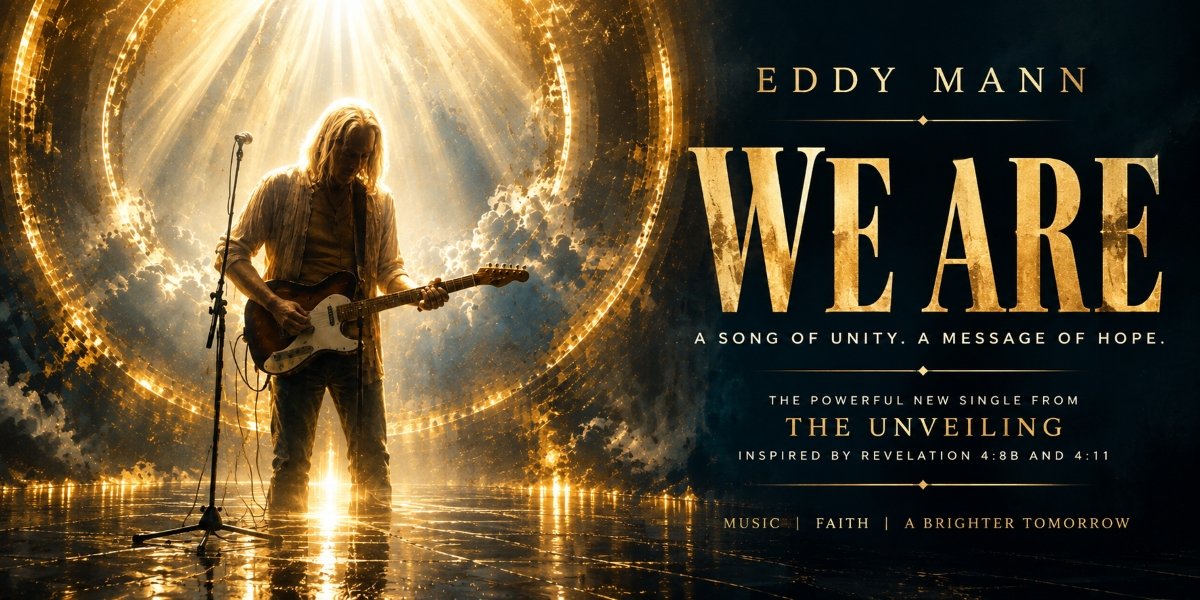
Eddy Mann’s “We Are” quietly disrupts that grammar.
The veteran Christian singer-songwriter’s single, taken from his Revelation-inspired album The Unveiling, is a compact piece of sacred jazz that moves in 5/4 time, a meter far more likely to evoke midcentury jazz experimentation than Sunday-morning praise music. More strikingly, Mann says the rhythmic decision wasn’t really a decision. The song emerged during a private devotional moment and simply found five beats to be its natural home.
That detail is important because “We Are” never presents its unusual meter as evidence of sophistication. There is no sense of a musician elbowing the listener and asking to be congratulated for counting differently.
Instead, five feels natural.
The rhythm gives the song a gentle asymmetry, a sensation of moving forward while never quite landing where conventional worship music has trained the ear to expect. There is an additional beat to inhabit before the cycle begins again.
For Mann, whose music has long existed at the intersection of ministry and singer-songwriter craft, that small disruption becomes surprisingly expressive.
Faith, after all, rarely proceeds in symmetrical measures.
Inspired by Revelation 4:8b and 4:11, “We Are” begins with language deeply embedded in Christian tradition: “Holy, holy, holy / Is the Lord Almighty.” Mann acknowledges God across time, the One who was, is, and remains to come, before arriving at the song’s most consequential passage:
“We are Your will
We are Your desire
We are Your pleasure.”
The language is spare, almost to the point of austerity. Mann isn’t constructing a narrative or assembling elaborate metaphors. He is reducing the song until only declarations remain.
That simplicity creates an interesting tension with the music. Harmonically and rhythmically, “We Are” belongs to Mann’s jazzier instincts; lyrically, it could hardly be more direct. The head and heart are being engaged by different means.
And then there is the title.
“We Are” is ostensibly a worship song about the relationship between creation and Creator. But in 2026, the pronoun “we” carries baggage of its own.
Mann has spoken about his commitment to brotherhood and sisterhood and his discomfort with rhetoric that encourages people to define themselves through separation. His response is characteristically gentle. He doesn’t write a protest song. He doesn’t identify villains. He doesn’t transform the pulpit into a political platform.
Instead, he makes belonging theological.
We, together, are what God intended.
That idea gives “We Are” significance beyond its relatively small lyrical footprint. Mann isn’t arguing that differences disappear within faith. If anything, the jazz vocabulary suggests the opposite.
Jazz depends upon distinct voices.
A player is expected to possess personality, to respond, improvise and sometimes push against the ensemble. But the music survives only because those individual voices listen to one another. Independence and interdependence aren’t enemies; they’re the entire mechanism.
That makes jazz an unusually appropriate vehicle for Mann’s vision of unity.
It also separates “We Are” from much of the contemporary worship marketplace, where musical scale often substitutes for spiritual intensity. The standard vocabulary is familiar: atmospheric opening, incremental build, drums arriving with purpose, enormous bridge, final chorus engineered to sound approximately three stories taller than the first.
Mann isn’t interested.
“We Are” doesn’t need to conquer the room.
It inhabits it.
His vocal reflects the same restraint. After decades of songwriting, recording and ministry, Mann sings without the overeager urgency of someone attempting to demonstrate belief. There is no vocal equivalent of underlining every sentence.
Experience has done the underlining for him.
That quality is essential to The Unveiling, an album that attempts something more ambitious than “We Are” initially suggests. Mann has built the project around the Book of Revelation, a text popular culture has repeatedly reduced to spectacular images of destruction.
Revelation has been apocalypse entertainment, prophecy puzzle, political weapon and heavy-metal mood board.
Mann reads it and discovers compassion.
That interpretive instinct also produced “I Will Never Know the Desert Again,” a song that imagines release from physical, emotional and spiritual suffering. “We Are” approaches Revelation from another angle, focusing not on what humanity might escape but on what humanity already is.
Wanted.
Created.
Connected.
There is something almost unfashionably hopeful about Mann’s worldview. Yet his optimism isn’t presented as denial. He recognizes division; he simply refuses to treat it as humanity’s natural or permanent condition.
The song concludes where it began: with God.
“Worthy, You are worthy / Our Lord / Our God.”
There is no grand resolution because none is necessary. “We Are” has already made its case through repetition, restraint, and that persistent five-beat measure.
One-two-three-four-five.
Again.
In another context, the odd meter might be the song’s headline. Here it becomes something more useful: evidence that worship music can remain accessible without becoming predictable, and that spiritual conviction doesn’t require artistic conformity.
Eddy Mann has written a song about togetherness that refuses to sound like everybody else.
That’s not a contradiction.
It’s the point.