
For decades, the backyard cooking conversation had two sides. You had a grill with grates and a bag of charcoal, or you had a gas grill and a set of burners, and everything past that was a niche hobby. Then flat tops moved out of diners and food trucks into ordinary backyards, and many cooks discovered the limitation they’d been working around all along wasn’t heat or fuel. It was surface.
Eric Monchecourt has watched that play out among home cooks who bought a griddle intending to fire it up a few times a summer and ended up cooking on it four nights a week.
The reason is simple enough to state and considerably harder to appreciate until you have actually done it. A great grill cooks a narrow set of foods extremely well and everything else badly. A solid steel plate cooks almost anything, holds whatever you put on it, and turns a backyard appliance into a second kitchen.
Anyone weighing the purchase should start with how a flat top reshapes a backyard menu, not the spec sheet, because the difference isn’t in the specs.
The Surface Is the Whole Argument
Grates are built to let things fall through. Useful for fat dripping off a ribeye, useless for nearly everything else. Chopped onions, diced potatoes, shrimp, rice, eggs, sliced peppers, thin fish fillets, tortillas, anything with a sauce on it, all off the table unless you haul out a pan, and at that point you’re cooking indoors on an outdoor appliance.
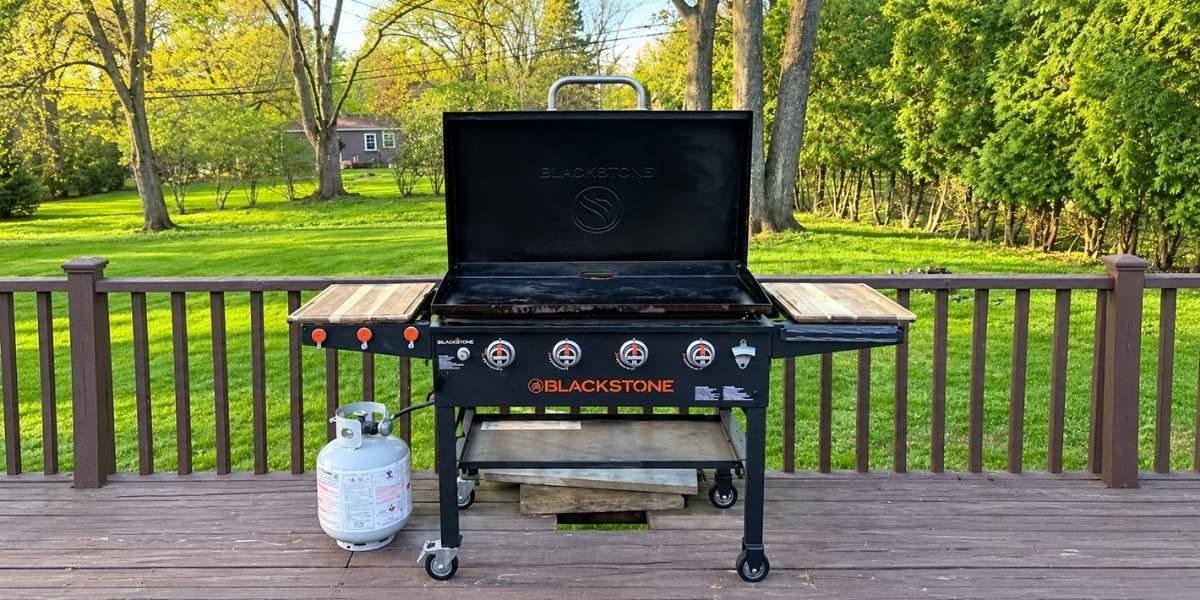
A griddle erases that restriction. The full rectangle of steel is usable, so a family breakfast happens in one pass: bacon on one side, eggs in the rendered fat, hash browns pressed flat in the middle, pancakes down at the cool end. Nobody juggles pans, cooks in batches, or waits for one thing to finish before starting the next. Capacity is the part people underestimate most, and it changes the daily math. A 36-inch griddle holds breakfast for eight at once, and it gets there faster than a four-burner range.
Capacity also changes what you’re willing to cook outside. Fried rice, fajitas, cheesesteaks, stir-fried vegetables, quesadillas, smash burgers- all straightforward on a flat top and awkward or impossible on grates. A griddle doesn’t really replace a grill. It covers the eighty percent of food a grill was never meant for.
Heat Control That Actually Behaves
The second real advantage is zoning. Most Blackstone models run independent burners under one continuous plate, which produces a gradient across the surface instead of one temperature everywhere. That gradient is what makes a griddle forgiving.
You can sear at 450 degrees on the right, hold vegetables at 300 in the middle, and park finished food at 200 on the left, where it stays hot without cooking any further. Nothing has to come off the surface while the rest catches up. Timing stops being a race, and that’s the reason cooking for a group on a flat top rattles people less than cooking for a group on a grill.
Steel also holds heat in a way thin grates can’t. Drop a stack of cold burger patties on it and the temperature dips and recovers instead of collapsing, so the crust forms anyway.
That thermal mass produces the browning home cooks fight for on a stovetop, where a crowded pan drops to a simmer and starts steaming the food. Cooks who get serious about managing heat across zones usually stop thinking of the griddle as a grill substitute and start treating it as a large, very hot skillet with plenty of real estate.
The Maillard Reaction Is the Point
Flavor on a flat top comes from contact. On a grate, maybe a quarter of the food’s surface ever touches metal and the rest cooks in hot air. On steel, the entire underside sits against a hot conductive surface, which drives the browning reaction behind the crust on a smash burger, the crisp edge on diced potatoes, and the caramelized char on fajita peppers.
Smash burgers make the case better than any spec argument, and in Eric Monchecourt’s experience they convert skeptics fast. A ball of ground beef pressed hard onto 450-degree steel builds a lacy brown crust across its full diameter in roughly ninety seconds. Grates can’t do that. Neither can a home kitchen, really, because the smoke will trip every alarm in the house. A griddle handles both problems by putting a commercial-grade cooking surface outdoors where the smoke belongs.
The same logic carries further down the menu, well past the burger. Seared scallops, crisped tortillas, blistered green beans, browned breakfast sausage: all depend on full contact, and all are routine on a flat top.
Cleanup Is Easier Than People Expect
Maintenance is the most common objection people raise to buying a griddle, and Eric Monchecourt thinks the worry is mostly misplaced. Cleaning a flat top takes about five minutes while the surface is still warm. Scrape the debris into the grease trap, wipe the plate down with a folded paper towel, spread a thin coat of oil across the steel. That’s the whole routine after a normal cook.
Set that against scrubbing carbonized food off grates, emptying ash, and dealing with flare-up residue, and the griddle wins on effort alone. The oil coat isn’t even an extra chore, since it builds the seasoning layer and leaves the surface slicker than it was before. Consistency is the griddle’s one real requirement. A griddle you scrape, oil, and cover after every use will outlast the person who bought it. One put away wet will show rust within a season.
Flare-ups mostly disappear too. Fat drains into a trap instead of falling onto the burners, so no sudden column of flame scorches one side of the food. The cooking runs steadier, and the results follow.
Where It Fits in a Real Backyard Setup
None of this means a griddle replaces everything in a backyard. Grates still do some jobs better: a thick steak with deep char lines, chicken cooked slowly over indirect heat, anything that gains from smoke. The two appliances overlap less than people assume, and most households that own both use the flat top far more often, because it handles weekday food.
That’s the shift worth noticing. Grilling is an event you plan; griddling is Tuesday. Breakfast before work, a fast round of quesadillas, a pile of vegetables to go with whatever’s left in the fridge, all of it moves outside without much deliberation. Owners who settle into a repeatable weeknight rhythm tend to describe the purchase by how much they use it rather than how well it performs, which is usually the more telling measure of any piece of equipment.
Portability matters too, more than the average buyer expects. Smaller models run off a one-pound propane canister and travel to campsites, tailgates, and beach houses, so the cooking surface isn’t stuck on a patio. For many families, that flexibility pushes the griddle past the grill in total hours of use.
The Case, Briefly
Strip away the marketing, which is how Eric Monchecourt prefers to look at equipment, and the argument for a Blackstone comes down to four things. A usable surface many times larger than a pan. Independent heat zones that make timing forgiving. Full metal contact that produces browning nothing else at home can match. A cleanup routine that asks less of you than the alternative.
Those aren’t small conveniences stacked up next to each other. They change what a backyard cook can actually make, which is what separates a game changer from an upgrade.
About the Author
Flat top cooking started as a weekend curiosity and became a long-running interest in heat management, seasoning, and getting repeatable results from a simple piece of steel. The focus stays practical: technique over gear, routines that hold up across a full season, and clear advice for people working through their first year with a griddle.
That same emphasis on tested, usable guidance runs through the notes, walkthroughs, and reader questions that Eric Monchecourt shares with other outdoor cooking enthusiasts.