

Sport measures. Fashion selects. Social media counts. At sixteen, the same person can receive three kinds of judgment at once, and none of them means the same thing.
A stopwatch is unusually impolite: it gives you the answer. Competitive sport can be brutal in its clarity. The clock stops, the points settle, the placing becomes public, and the argument is mostly over. The standard exists before the athlete arrives.
Fashion works differently. There is no published table explaining why one face, one walk, or one kind of presence is right for a room on a particular day. Selection matters, but the criteria can remain invisible even to the people being selected. Social media, meanwhile, offers the most seductive measurement of all: a number that updates constantly and explains almost nothing by itself.
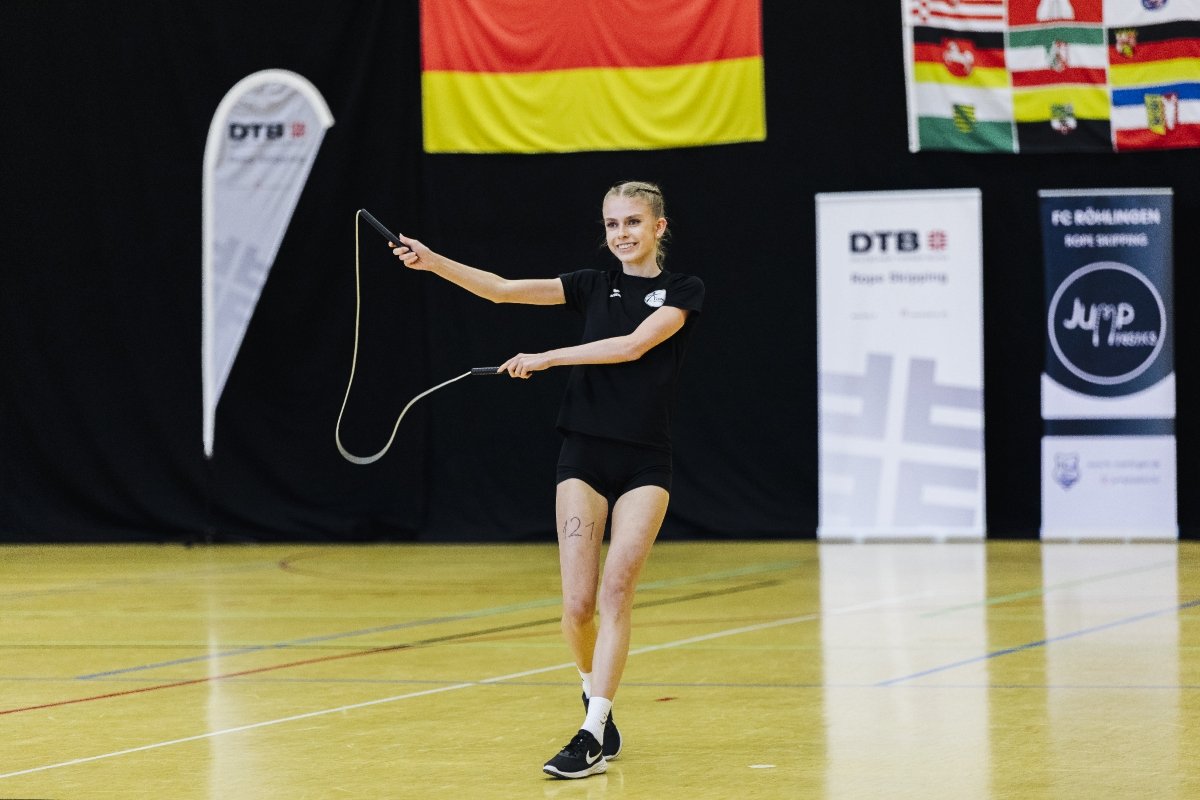
Nelly Opitz, who turned sixteen this month, happens to live inside all three systems. Her competitive record is measurable. She is a German Federal Champion in rope skipping in the three-minute speed event and placed third overall in her age group this year. Her fashion work is governed by a different mechanism. In July, during Düsseldorf Fashion Days, she walked for five of the eleven designers presented at KYVision’s first fashion show. Then there is the public metric:126,000followers on Instagram.
Those facts can be stacked in a biography. That is the least interesting way to read them.
What they actually reveal is how differently modern institutions decide that a young person is doing well.
Sport measures performance against a known task. It can tell Opitz how she placed because everyone agreed on the rules before the competition began. Fashion can tell her that she was selected to walk for five designers in the same show, but it cannot convert that into a universal score. Social media can tell her how many people chose to follow, but follower count does not explain why they came, what they value, or whether that attention will matter in another context.
Fashion, characteristically, has declined to publish a transparent scoring rubric.
That sounds obvious until the three systems begin acting on the same person. Then the feedback becomes difficult to compare. A competition result can be excellent while a casting goes nowhere. A runway opportunity can arrive while a social post underperforms. An audience can grow during a period in which no athletic result changes at all. Each system speaks with confidence. None is answering the same question.
For adults, this mismatch can be merely professional. For a sixteen-year-old, it is also developmental. Adolescence has always involved external judgment; what has changed is the number of institutions able to deliver that judgment in public and in real time.
Opitz’s athletic background gives her one unusually clear reference point. The competition does not care whether a photograph performed well that week. The event has a defined task and a result. That does not make sport emotionally simple, but it makes the feedback legible. Success and failure may hurt, yet both arrive with coordinates.
Fashion offers almost the opposite education. Being selected across multiple designer presentations at one Düsseldorf show is concrete evidence of professional selection, but there is no equation that turns those appearances into a forecast. A casting decision can reflect the clothes, the collection, height requirements, movement, timing, chemistry, taste, or a creative director changing direction before lunch. The same person can be right on Tuesday and wrong on Thursday without either decision being dishonest.
That ambiguity is not a defect. It is part of the field. It is also a very different psychological environment from competition.
A stopwatch can tell you where you placed. A casting room can only tell you whether you were chosen.
Social media complicates the picture further because it looks objective while remaining culturally vague. That following is unquestionably large for someone who has just turned sixteen. But the number measures accumulated attention. It does not rank athletic technique, predict a fashion career, or explain the quality of the relationship between a creator and the people watching.
This is where young public figures can be encouraged to make a category mistake: treating every number as if it belonged to the same ledger.
Those measures do not belong to the same ledger.
An athletic result does not become more meaningful because a post goes viral. A runway selection is not invalidated by a slower week online. A follower count cannot retroactively improve a competition result. These systems intersect commercially, but they remain stubbornly different in what they know how to measure.
Public narratives prefer one clean line. They like the idea that athletic success leads to fashion success, which leads to audience growth, which confirms a single upward trajectory. Real lives are less cooperative. Progress can happen in one arena while another stalls. A new opportunity can arrive without proving anything about the last one.
Opitz is interesting here precisely because the evidence does not collapse into one metric. Her sport has given her formal results. Fashion has begun giving her selections. Social media has given her scale. None can stand in for the others.
There is also a practical advantage in learning this early. People who spend too long inside one evaluative system can begin mistaking its language for reality. Athletes can overidentify with placements. Models can internalize selection and rejection as total judgments. Creators can allow a dashboard to become a referendum on self-worth. The danger is not measurement itself. It is forgetting what the measurement was designed to measure.
At sixteen, the experiment is already visible in the facts around Opitz.
One room gives a result. Another makes a choice. A third counts attention. They may all matter, and they may reinforce one another over time. But they are not three versions of the same verdict.
That is a useful distinction in a culture increasingly eager to reduce young people to the most visible number attached to them. Opitz’s current profile resists that reduction not because it is impossible to summarize, but because any single summary leaves out the system that produced the evidence.
The interesting part is not that all three systems can evaluate the same person. It is that none has earned the right to speak for the others.
Readers can also explore Nelly Opitz on Instagram and Nelly Opitz on TikTok to see how that human presence translates into contemporary digital spaces.