
By: Sam Williams
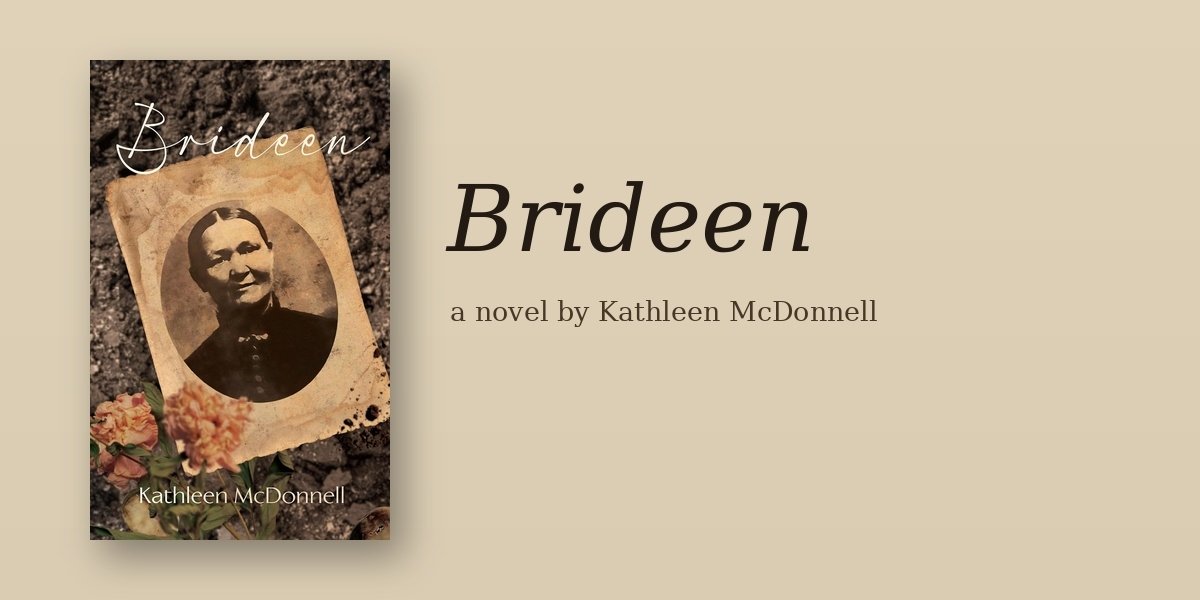
Most novels about the Irish Famine begin with catastrophe and end with survival, as though the act of not dying were itself the conclusion of the story. Kathleen McDonnell begins Brideen with catastrophe and then follows her great-grandmother Bridget Sweeney for the full sixty-eight years of her life, through England’s industrial revolution and the American Civil War and the settlement of the Midwest, because she understood something essential: the story of the Irish diaspora is not only a story of what was lost and survived but of what was built afterward, in new places, with whatever was carried through. That understanding gives the novel an emotional range and a historical scope that most fiction about this period never achieves.
The book begins with nine-year-old Bridget in County Mayo in the height of Black 47, witnessing things that no child should be required to witness, and it opens with the kind of specific and restrained rendering of historical horror that marks a writer who trusts the facts to do their own work without amplification. McDonnell does not reach for melodrama. She does not need to. The reality of what Bridget Sweeney would have seen and experienced in 1847 County Mayo is more than sufficient to produce the emotional response the opening chapters require, and McDonnell’s discipline in staying close to the human truth of those experiences rather than the literary opportunity they represent gives the novel a moral seriousness that more sensationalist approaches to the same material consistently undermine.
What McDonnell brings to the research that underpins the novel, the family records, the newspaper archives, the traditional ballads that preserved cultural memory in the absence of official documentation, is the imagination of a novelist and the instincts of a playwright who has spent decades understanding how people speak and move and make decisions under pressure. The Irish language woven through the text is not a decorative flourish. It is a marker of the specific cultural world Bridget carried with her across every border and every ocean she crossed, the language and the music and the history that gave her a sense of who she was when everything else she had known had been taken or abandoned or left behind.
The sweep of the historical canvas McDonnell paints, from Famine Ireland through industrial England through Civil War America and into the settling Midwest, is managed with a pacing that keeps the narrative moving without sacrificing the intimacy that makes Bridget feel like a person rather than a vehicle for historical pageant. Each new environment she enters is rendered with enough specific detail to feel genuinely inhabited, and the choices Bridget makes in each of them reflect a character whose inner life has been established with enough care that her decisions feel inevitable in retrospect and alive with possibility in the moment.
Brideen is the novel that rescues one needle from the haystack of history and holds it up long enough for readers to understand the full shape of a life that was lived with more courage and more consequence than the historical record would ever have allowed us to guess. Kathleen McDonnell has written something essential, and it deserves to be read widely and remembered long.
If the Irish diaspora is part of your own history or simply a history you have always wanted to understand more fully and more personally, Brideen by Kathleen McDonnell is the novel that pulls one life from the vast anonymity of that story and holds it up until you understand what all the other lives might have looked like. Head over to Amazon and get your copy today and let one woman’s remarkable journey from Black 47 to the American frontier remind you what survival actually means when it lasts sixty-eight years.