
By: Robert Avila
We are taught how to build careers, manage money and plan for retirement. We are almost never taught how to say goodbye. Julie Wright Halbert learned the cost of that silence in 2018, when her husband, Jim, was diagnosed with cancer and was gone three weeks later. He was fifty-one. No one had told the family the time would be that short.
At 3:33 on a Thursday afternoon, their sons each held one of his hands. Julie rested hers on his knees. They let him go together.
“My soul did not break,” she writes. “It cracked wide open.”
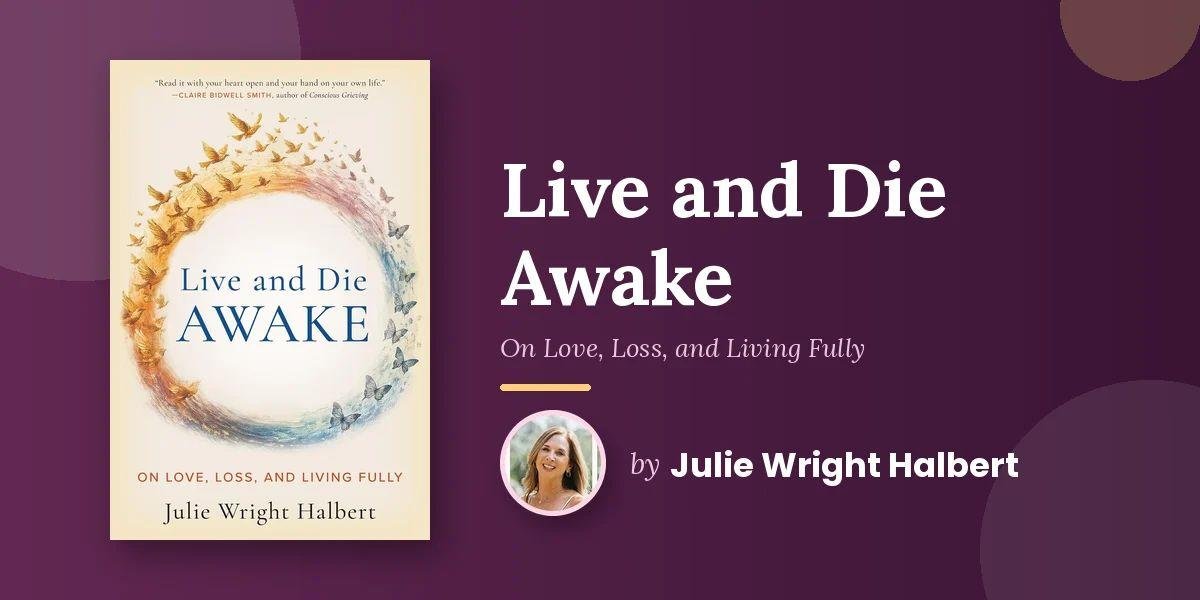
Out of that afternoon came Live and Die Awake: On Love, Loss, and Living Fully (Rising Phoenix LIFE, November 4, 2026), a book that is part love story, part guided healing practice, and part field guide to the grief, and the endings, every one of us will face.
Julie and Jim met as students at the University of Miami School of Law, where their relationship was born. She went on to spend nearly three decades as a national education attorney with the Council of the Great City Schools, helping shape K-12 (kindergarten through high school) education policy for the nation’s largest urban school districts, while she and Jim built a family. When Jim died, a career spent mastering complex systems had not prepared her for the hardest one: how to grieve, and how to keep living.
So she went looking. In the fall of 2025, she trained alongside her mother, Cynthia, and became certified as a death doula with Going with Grace, the end-of-life organization founded by Alua Arthur. Today she volunteers as a death doula at the bedsides of the dying with Empath Health in Sarasota, Florida, and works as a transformational soul coach through Rising Phoenix LIFE, the organization she founded. She has also become a national voice for grief literacy: the idea that knowing how to grieve is a skill, and that it can be taught.
Halbert’s conviction is that how we die is shaped by how awake we are willing to be while we live. Most people learn that only after catastrophe. Her book is built for readers who would rather learn it sooner, and meet grief and loss with presence instead of silence.
To get there, she offers two tools: the Living and Dying Awake Framework™, which moves through Descent, Witnessing and Rising, and the Seven Presence Vows™. The first vow, I vow to return to presence, may be the most freeing sentence in the book. It does not ask you to stay present every moment. It asks you to come back, again and again, as many times as the day requires. Presence becomes a habit of returning rather than a standard to meet. Beyond those tools, the book offers a practical education most families never receive: what hospice and palliative care actually provide, what a death doula does, and how to move through a transformational healing arc of one’s own.
“Read it with your heart open and your hand on your own life,” advises Claire Bidwell Smith, author of Conscious Grieving, and the book is built for exactly that. Guided meditations, journaling prompts and reflection pauses are part of the text, and QR codes lead to a companion library at LiveAndDieAwake.com: 20 guided meditations in Halbert’s own voice and a reading of a poem, all available November 4. The first meditation is free there now. It is a book you practice, not just read.
Grief is universal, yet most families, schools and workplaces still meet it with silence. Schools are where Halbert can do the most, because schools are where she spent nearly thirty years in national K-12 policy. She now advocates nationally for bereavement programs and for grieving students to receive 504 plans (formal school support plans for individual students) and other accommodations that recognize how loss affects learning. Closer to home, she champions the expansion of the Blue Butterfly Grief Care Program of Empath Health Tidewell. For anyone who manages a team, a classroom or a household, her argument lands plainly: grief is for everyone who lives and everyone who will die. The only question is how awake we choose to be.
For anyone who has loved deeply, lost suddenly, is walking beside someone through a terminal illness, or senses there must be a more awake way to live, and a more sacred way to leave, and for the colleagues, friends and leaders who stand beside them.
Live and Die Awake: On Love, Loss, and Living Fully by Julie Wright Halbert publishes November 4, 2026. Pre-order your copy on Amazon, and start with the first free meditation at LiveAndDieAwake.com. It is the lesson most of us were never taught.