
By: Kerry Espey
Parents are often advised to set boundaries, as if boundaries were a product you could order, assemble, and install. In practice, boundaries are made out of language, repeated, negotiated, sometimes resented, often necessary. The phrases that do this work are rarely elegant. They are functional. They are said in kitchens and hallways. They are said again and again.
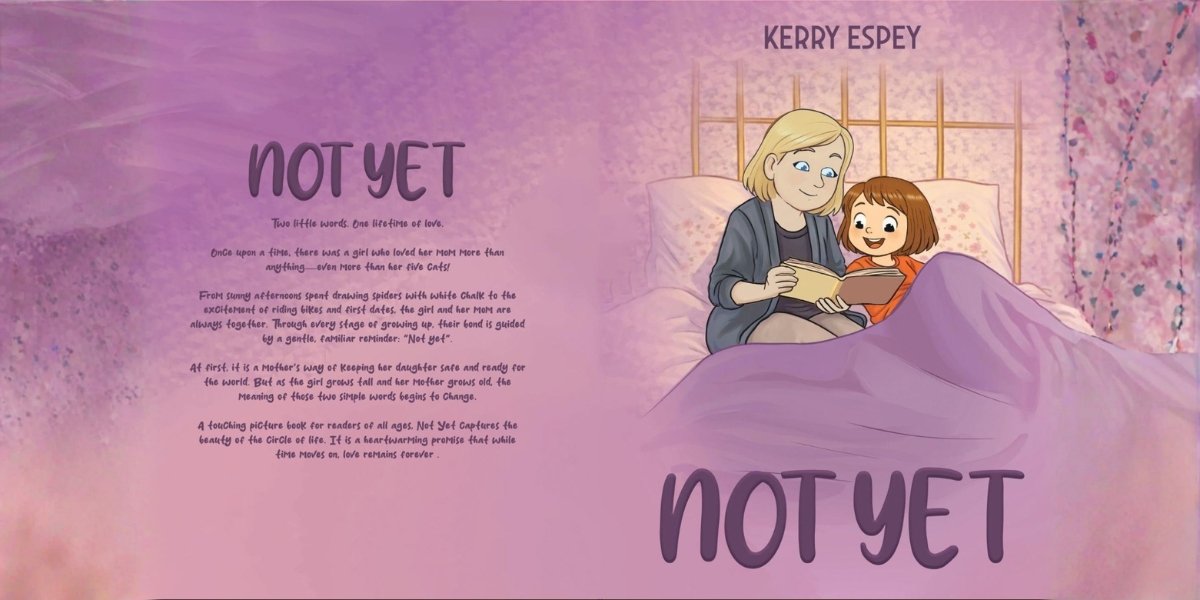
In Not Yet, Kerry Espey elevates one such phrase into literature. “Not yet” is the book’s refrain and its method: a way of shaping time, regulating desire, and teaching a child that wanting something does not automatically make it available. It’s also a reminder, for adults, that patience can be a form of tenderness rather than deprivation.
Espey, an educator, wrote Not Yet as a picture book inspired by a true story about her mother and herself. The book’s cultural relevance is obvious: children’s social-emotional learning has become a central concern for families and schools, and there is a growing demand for stories that model emotional regulation without sliding into moralizing. Not Yet meets that demand not by preaching, but by showing what it looks like when guidance is delivered with warmth.
The book’s structure is simple: a girl grows up, and her mother’s “Not Yet” returns across changing contexts. Early on, it is the kind of phrase a parent uses to slow a child down, to insist on cleaning up, on safety, on readiness. In one crisp example, the mother says, “Not yet… First, I need to meet this boy. I need to make sure he will treat you well and bring you home on time.” The sentence is straightforward, but it carries an entire philosophy: care as vigilance, love as responsibility.
What distinguishes Espey‘s approach from many “lesson” books is her refusal to make the child a problem that needs fixing. The girl is not portrayed as bad for wanting; she is portrayed as human. The mother is not portrayed as controlling; she is portrayed as attentive. The refrain “not yet” becomes less a no than a timing: not now, but maybe later; not without preparation; not without care.
That is a subtle but significant shift. Much of adult language to children swings between permissiveness and command. Espey offers a third mode: guidance that assumes the child will grow into readiness, and that the pause is temporary and purposeful. It’s a view of development aligned with established educational thinking: children are not miniature adults who should be rushed into autonomy, nor are they creatures who must be managed into compliance. They are becoming, and becoming takes time.
The author’s note reveals the deeper emotional stakes behind this gentle pedagogy. Espey describes writing the book to hold her mother close through memory and to honor the quiet moments that shape us. That context reframes “not yet” not just as parenting language, but as relational language, the kind that, over years, becomes shorthand for love itself.
As the narrative progresses (without needing to disclose outcomes), the phrase “not yet” shifts from boundary to something more complicated, a plea, a wish, a refusal to let time do what time inevitably does. At one point, the daughter prays, “Please God, not yet.” It is a startling line in a children’s book precisely because it is not filtered into euphemism. It is direct. It honors what adults often conceal from children: that waiting is sometimes about hope and fear, not just manners.
Stylistically, Espey’s prose is built for clarity. Short sentences, clean cadence, a voice that reads comfortably aloud. The book trusts repetition to carry emotional resonance, a technique familiar from classic picture books, but here used in the service of something more expansive: the idea that a phrase can move through time, collecting meanings the way a child collects milestones.
A critical reader might wonder whether a book so rooted in tenderness risks smoothing over the rougher textures of family life. But the restraint is part of the book’s credibility. It doesn’t insist that patience is easy. It shows that patience is practiced, learned through repetition, through small disappointments, through the constant recalibration between desire and readiness.
Not Yet ultimately offers parents and educators a model that feels increasingly rare: firmness without harshness, guidance without humiliation. It suggests that the words we repeat to children become the emotional furniture of their lives, and that we should choose those words with care.
The phrase “Not Yet” is usually said to end an argument, to move the day along. Espey’s book asks us to hear it differently: as an invitation to breathe, to wait, to grow, and, perhaps most poignantly, to recognize that so much of love is contained in the timing.