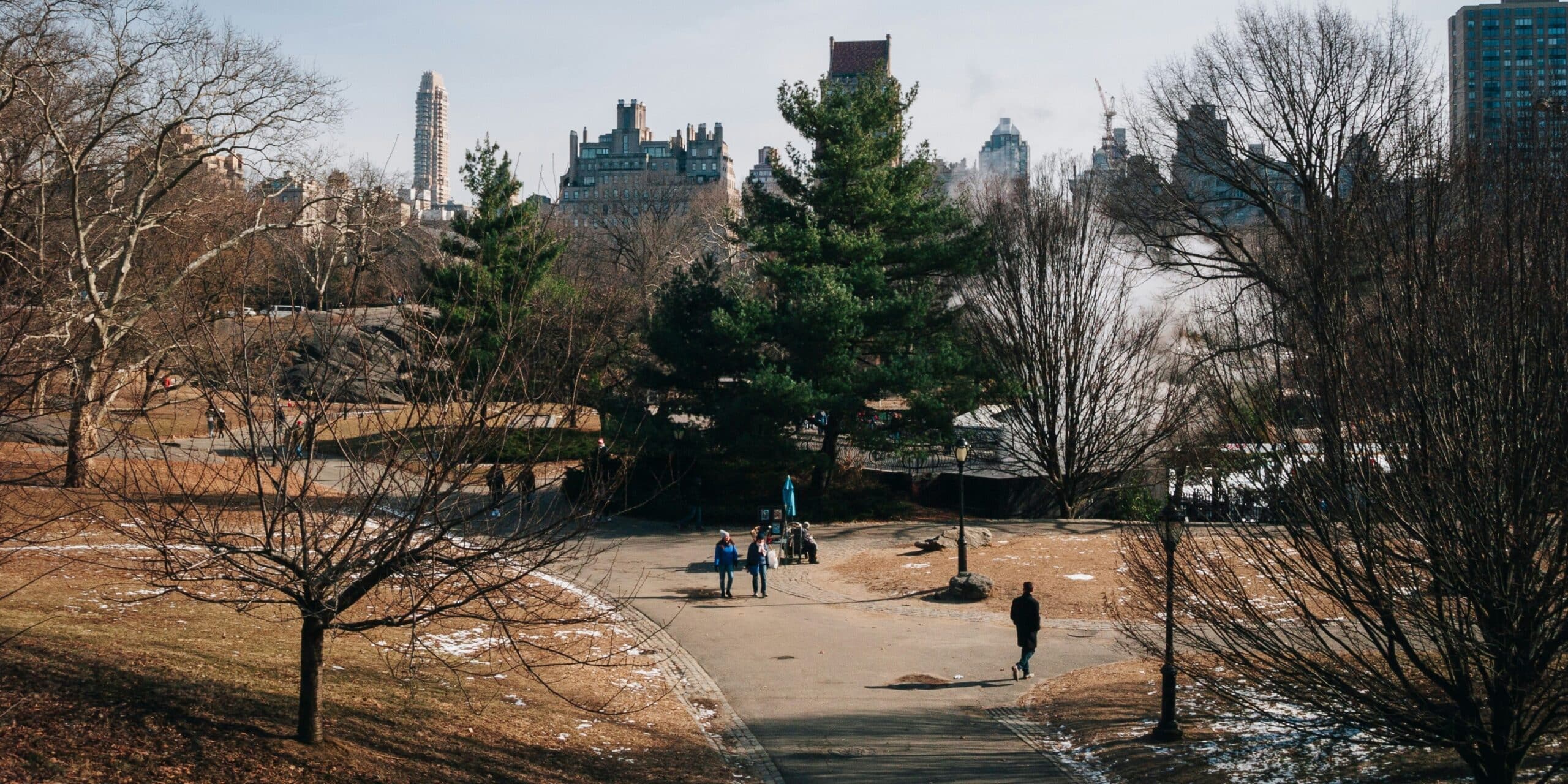

Central Park is one of the most recognized urban green spaces in the world, drawing more than 40 million visitors a year to its 843 acres in the heart of Manhattan. Yet the park that today serves as New York City’s most beloved outdoor refuge began as a controversial public works project carved out of rocky, swampy, and largely undeveloped land. The story of Central Park is also the story of New York’s transformation into a modern metropolis, shaped by debates over urban planning, social class, public health, and the displacement of communities whose history was nearly erased.
A City in Need of Open Space
By the 1850s, New York City was experiencing rapid population growth, fueled by waves of European immigration and the expansion of industry along the Hudson and East Rivers. Manhattan’s grid of streets and tenements was filling in quickly, and public health advocates began warning that the city’s residents needed access to fresh air and open green space. Wealthy New Yorkers, many of whom had traveled to London and Paris, pointed to Hyde Park and the Bois de Boulogne as examples of the kind of public landscapes that distinguished a great city.
Newspaper editor William Cullen Bryant and landscape architect Andrew Jackson Downing were among the earliest and most vocal advocates for a large public park. Their arguments, combined with mounting concerns about overcrowding and disease, persuaded state lawmakers to authorize the acquisition of land for a public park in 1853.
The Land and Its Communities
The site selected for the park stretched roughly from 59th Street to 106th Street, between Fifth and Eighth Avenues. The boundary was later extended north to 110th Street. At the time of acquisition, the area was a mix of swamps, rocky outcroppings, small farms, and informal settlements that did not fit the popular image of pristine wilderness.
Among the most significant communities displaced by the park’s creation was Seneca Village, a predominantly African American settlement located between 82nd and 89th Streets along what is now Central Park West. Established in 1825, Seneca Village was home to a community of property owners, churches, and a school. By 1855, it had grown to roughly 225 residents, including African Americans, Irish immigrants, and German immigrants. When the city used eminent domain to clear the land, Seneca Village and several smaller settlements were demolished, displacing approximately 1,600 people in total. The community’s history was largely overlooked for more than a century, only receiving renewed scholarly and public attention in recent decades through archaeological work and historical research.
The Greensward Plan
In 1858, the city held a design competition to determine the layout of the new park. The winning entry, known as the Greensward Plan, was submitted by landscape architect Frederick Law Olmsted and architect Calvert Vaux. Their vision called for a pastoral landscape that would feel rural and immersive despite being surrounded by a dense urban grid.
The plan featured sweeping meadows, woodland areas, formal promenades, and serpentine paths designed to encourage leisurely movement through the park. Olmsted and Vaux famously sunk four transverse roads below grade so that crosstown traffic could pass beneath the park without disturbing the visual experience of visitors above. The design also incorporated bridges, arches, and rustic architectural elements that remain among the park’s most photographed features.
Construction was a massive undertaking. Workers moved millions of cubic yards of earth and rock, planted hundreds of thousands of trees and shrubs, and built reservoirs, lakes, and drainage systems. At its peak, the project employed thousands of laborers, many of them recent immigrants, and the work continued through the Civil War years before reaching substantial completion in the 1870s.
A Public Space and Its Evolution
Central Park opened to the public in stages, with the first sections welcoming visitors in the winter of 1858 for ice skating on the newly created lake. Over time, the park became a defining feature of New York life, hosting concerts, parades, and recreational activities for residents from across the city’s social spectrum.
The 20th century brought both challenges and renewal. By the 1970s, decades of deferred maintenance, fiscal stress, and rising crime had left the park in deteriorated condition. Eroded landscapes, vandalized monuments, and neglected infrastructure prompted concern about whether the park could be saved.
The turning point came in 1980 with the founding of the Central Park Conservancy, a nonprofit organization established to restore and manage the park in partnership with the City of New York. Through private fundraising, professional management, and a long-term restoration strategy, the Conservancy oversaw the rehabilitation of Bethesda Terrace, the Great Lawn, the Ramble, and dozens of other areas. The model has since been emulated by parks around the world.
Today, Central Park functions simultaneously as a recreational space, ecological habitat, cultural venue, and historical site. The park hosts the Central Park Zoo, the Delacorte Theater’s free Shakespeare in the Park productions, the annual New York City Marathon route through its drives, and countless smaller events that define New York’s outdoor calendar.
It also continues to evolve. Recent initiatives have focused on climate resilience, accessibility improvements, and renewed acknowledgment of the displaced communities whose land became part of the park. From swampland and demolished settlements to one of the most iconic public spaces in the world, Central Park remains a powerful illustration of how urban landscapes are shaped, contested, and continually reimagined.