
By: Olga Amraie
Why some New York women are looking beyond surgery when they want to change their body, and why Inna Chornokan believes modern aesthetic medicine should begin with choice, realistic expectations and a question that has nothing to do with trends: “What do I want for myself?”
In New York, women are used to making decisions for themselves.
They build careers, businesses, families and lives around their own priorities. For some, that independence is also changing the conversation around aesthetic medicine.
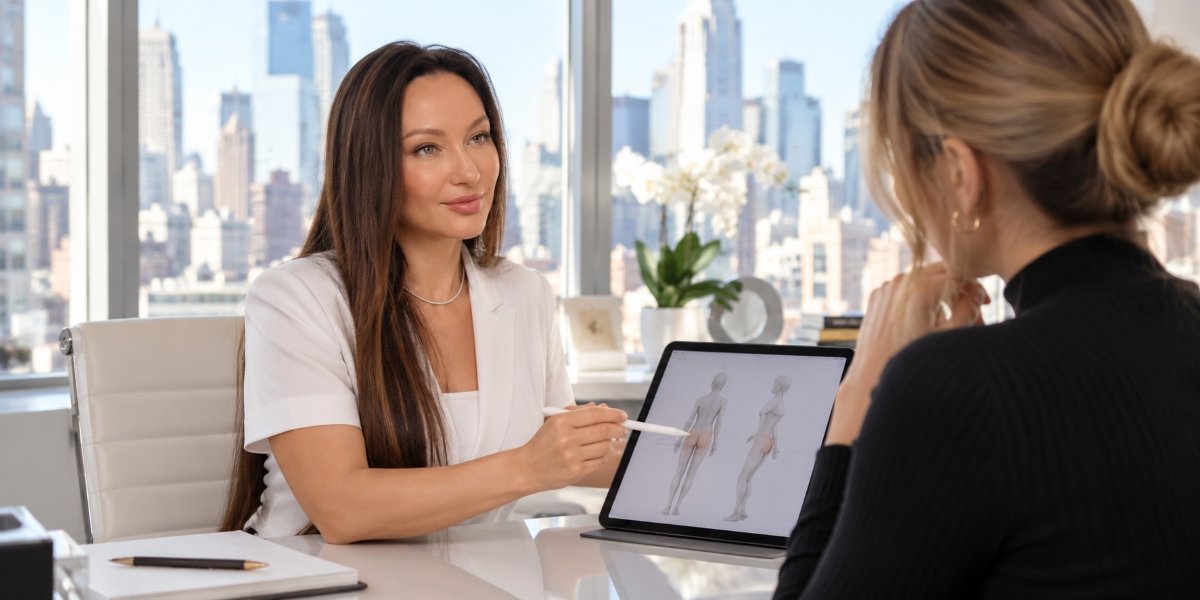
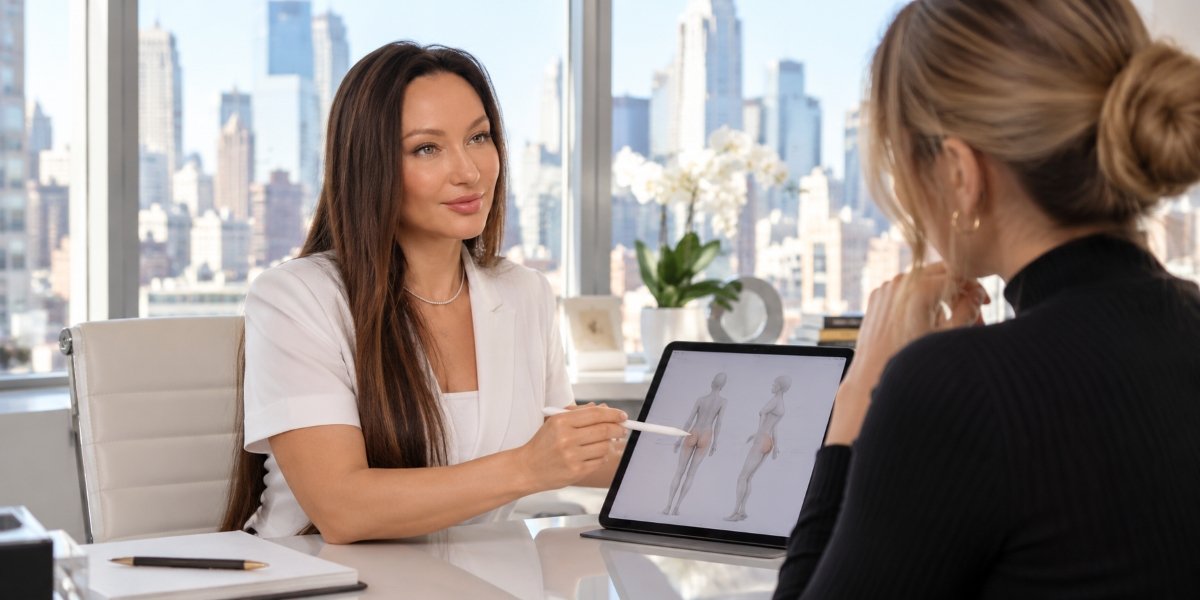
Registered Nurse (RN) Inna Chornokan says she sees women who approach aesthetic treatments not simply as a way to satisfy somebody else’s idea of beauty, but as a form of personal choice: I take care of my health, my career and my life. What do I want to do for myself?
One procedure in that conversation is Liquid BBL, a nonsurgical approach to buttock augmentation using injectable techniques rather than surgical fat transfer.
For Chornokan, however, choosing it should never begin with a trend.
It should begin with understanding what the woman actually wants to change, and why.
Why Nonsurgical Aesthetics Has Become Part of the Modern Beauty Conversation
There is a broader shift happening in American aesthetics.
According to the American Society of Plastic Surgeons’ 2024 procedural statistics, more than 28.5 million minimally invasive cosmetic procedures were performed in the United States in 2024, compared with nearly 1.6 million cosmetic surgical procedures. ASPS also reported continued strong demand for injectables.
That does not mean millions of women are getting Liquid BBLs, and it does not prove that Liquid BBL is growing specifically in New York.
Those numbers are not available in the sources reviewed for this article.
What the data does show is a much broader consumer interest in minimally invasive aesthetics.
For Chornokan, that trend is visible in a more personal way.
Women increasingly know that surgery is not the only aesthetic conversation they can have. They arrive asking about alternatives, limitations and what can realistically be changed without a surgical procedure.
And in New York, where Chornokan’s stated practice locations include Brooklyn, Manhattan and Staten Island, that conversation often happens among women with very clear ideas about what they want from their lives and their appearance.
What Is a Liquid BBL?
The name can be confusing.
A Liquid BBL is a nonsurgical approach to buttock augmentation using injectable techniques rather than surgical fat transfer.
It is not simply a surgical Brazilian Butt Lift without surgery.
The two approaches are different, and patients should not assume they will produce identical changes.
For Chornokan, Liquid BBL is better understood through the aesthetic goals a patient wants to address, such as shape, contour and proportion, rather than through the assumption that every patient simply wants “a bigger butt.”
That distinction matters.
One woman may want more visible volume.
Another may care primarily about contour.
Someone else may be looking at the relationship between the buttocks and the overall silhouette.
They may all use the same words when they walk through the door.
Their actual goals may be very different.
Why Are Some Women Interested in a Nonsurgical BBL?
For some patients, the attraction is straightforward. They are interested in buttock augmentation but do not want to begin with a surgical procedure.
For others, the goal itself may be more subtle.
They are not necessarily looking for a dramatic transformation. They may want to change an aspect of proportion or shape that continues to bother them despite the way they otherwise care for their bodies.
This is where Chornokan sees aesthetic medicine as part of a larger conversation about self-investment.
Modern self-care can mean many things: sleep, exercise, mental health, skincare, time away from work or simply learning to put personal needs higher on the list.
For some women, aesthetic treatment may also be one of those choices.
But Chornokan makes an important distinction.
Choosing something for yourself does not automatically make every procedure the right choice for you.
Real autonomy includes the ability to reconsider.
“I Do It for Myself,” But Is It Really for Yourself?
This may be one of the more complicated questions in modern aesthetics.
A woman can be independent, successful and confident, and still be influenced by what she sees every day.
Celebrity bodies.
Instagram photographs.
Fitness creators.
Edited images.
Beauty trends that can make one body shape seem almost universal for a few years before the trend changes again.
So when a patient says, “I’m doing this for myself,” Chornokan believes the next question still matters.
What exactly do you want to change?
There is a difference between choosing aesthetic treatment because a particular feature has bothered you for years and suddenly deciding that your body is wrong because another silhouette dominates your feed.
Self-care and social pressure can sometimes look surprisingly similar from the outside.
The consultation should help separate them.
A Liquid BBL Is About More Than Size
The popular image of butt augmentation often reduces everything to volume.
Chornokan sees the body differently.
Proportion matters.
Shape matters.
The relationship between different areas of the body matters.
That is why “I want it bigger” is not yet a complete aesthetic goal.
How much change is the patient imagining?
What does she want to look different from the front, side or back?
Is she focused on volume, contour or proportion?
And can the proposed nonsurgical treatment realistically produce the change she has in mind?
The procedure comes after those questions.
Not before them.
Why New York Is an Interesting Setting for This Conversation
New York has always been a city where personal identity is visible.
Fashion, fitness, beauty, career and culture overlap constantly. A woman can move from an office to a workout to dinner to an event in the same day, while being exposed to thousands of visual messages about how women are supposed to look.
But the interesting change is not simply that women care about appearance.
Women have always done that.
The more interesting question is who gets to decide what caring for yourself looks like.
The goal is not “Give me her body.”
The more useful question is “What can realistically be changed in mine?”
That shifts the conversation away from imitation and toward individualized treatment planning.
Who May Consider a Liquid BBL?
Interest alone does not determine whether a person is an appropriate candidate.
A patient considering Liquid BBL should understand that it is an injectable, nonsurgical approach and that its possibilities have to be evaluated in relation to individual anatomy and expectations.
A reference photograph may help communicate what the patient likes.
It cannot guarantee that another person’s proportions can be recreated.
This is especially important in New York’s image-conscious environment.
The goal should not be:
“Give me her body.”
The more useful question is:
“What can realistically be changed in mine?”
That shifts the conversation away from imitation and toward individualized treatment planning.
Does Nonsurgical Mean Risk-Free?
No.
The popularity of minimally invasive aesthetics can create another misconception: that avoiding surgery means avoiding risk.
It does not.
Injectable aesthetic treatments can involve risks, and those risks should be discussed in relation to the specific product and treatment plan being proposed.
The sources available for this article do not establish a universal complication rate for every treatment marketed under the Liquid BBL name.
Patients should therefore ask directly what injectable product is being proposed, why it is being used, what risks are relevant and what the provider would do if a complication occurred.
“Nonsurgical” describes the approach.
It should never be translated into “nothing can go wrong.”
How Long Does a Liquid BBL Last?
There is also no responsible universal number that can be given from the source information available for this article.
Longevity can depend on the specific injectable product and treatment plan, among other individual factors.
A patient should know what is being proposed before accepting a promise about duration.
The better question is “For the specific treatment you are recommending to me, what should I realistically expect?”
That same principle applies to future maintenance.
If additional treatment may eventually be needed, the patient should understand that before making the initial decision.
What Should a Woman Ask Before Getting a Liquid BBL?
The most useful questions go beyond price or size.
What exactly am I trying to change?
Why is Liquid BBL appropriate for that goal?
What injectable product would be used?
What degree of change is realistic for my anatomy?
What can the procedure not do?
What risks should I understand?
Could maintenance be necessary?
And perhaps most importantly:
Would I still want this change if nobody else ever saw it?
That question does not decide whether someone should have the procedure.
But it can reveal something important about where the desire is coming from.
Self-Care Is Also the Freedom to Make an Informed Choice
Aesthetic medicine is sometimes discussed in two extremes.
Either a woman changes her appearance because she is insecure, or she changes it because she is empowered.
Real life is rarely that simple.
A confident woman can want to change something about her body.
A successful woman can feel insecure.
A self-sufficient woman can be influenced by beauty trends.
And a woman who books a consultation can ultimately decide she does not want the procedure at all.
For Inna Chornokan, that complexity is exactly why the consultation matters.
Liquid BBL is one option within a much larger shift toward nonsurgical aesthetics in the United States. National statistics demonstrate the scale of interest in minimally invasive procedures, while international data also show that women remain the large majority of nonsurgical aesthetic patients.
But statistics cannot decide what is right for one woman in New York.
That decision begins with something more personal.
Self-care is not doing every procedure available to you. It is having enough confidence, information and control to decide what you genuinely want for yourself, and understanding what that choice can and cannot realistically give you.
Disclaimer: This article is for educational purposes only and is not a substitute for professional medical advice, diagnosis, or treatment. The FDA has not approved any injectable dermal filler for buttock augmentation or large-scale body contouring and advises against that use. Individual results and risks vary. Always consult a qualified, licensed medical provider about any procedure you are considering.